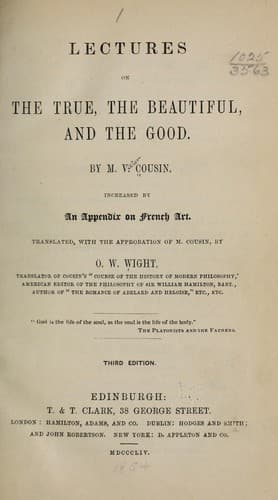
Lectures on the true, the beautiful and the goodCousin, Victor
Philosophy
Lectures on the true, the beautiful and the good
Cousin, Victor
Aesthetics; Ethics; Truth
We have made known the beautiful in ourselves, in the faculties that
perceive it and appreciate it, in reason, sentiment, imagination, taste;
we come, according to the order determined by the method, to other
questions: What is the beautiful in objects? What is the beautiful taken
in itself? What are its characters and different species? What, in fine,
is its first and last principle? All these questions must be treated,
and, if possible, solved. Philosophy has its point of departure in
psychology; but, in order to attain also its legitimate termination, it
must set out from man, and reach things themselves.
The history of philosophy offers many theories on the nature of the
beautiful: we do not wish to enumerate nor discuss them all; we will
designate the most important.[103]
There is one very gross, which defines the beautiful as that which
pleases the senses, that which procures an agreeable impression. We will
not stop at this opinion. We have sufficiently refuted it in showing
that it is impossible to reduce the beautiful to the agreeable.
A sensualism a little more wise puts the useful in the place of the
agreeable, that is to say, changes the form of the same principle.
Neither is the beautiful the object which procures for us in the present
moment an agreeable but fugitive sensation, it is the object which can
often procure for us this same sensation or others similar. No great
effort of observation or reasoning is necessary to convince us that
utility has nothing to do with beauty. What is useful is not always
beautiful. What is beautiful is not always useful, and what is at once
useful and beautiful is beautiful for some other reason than its
utility. Observe a lever or a pulley: surely nothing is more useful.
Nevertheless, you are not tempted to say that this is beautiful. Have
you discovered an antique vase admirably worked? You exclaim that this
vase is beautiful, without thinking to seek of what use it may be to
you. Finally, symmetry and order are beautiful things, and at the same
time, are useful things, because they economize space, because objects
symmetrically disposed are easier to find when one wants them; but that
is not what makes for us the beauty of symmetry, for we immediately
seize this kind of beauty, and it is often late enough before we
recognize the utility that is found in it. It even sometimes happens,
that after having admired the beauty of an object, we are not able to
divine its use, although it may have one. The useful is, then, entirely
different from the beautiful, far from being its foundation.
Public-domain text, read in full here on John Shaqi.
Reviews
Reviews
No reviews yet
Be the first to share your thoughts on this work.
Elsewhere in the archive
Join the Discussion
Join the discussion
Sign in to leave a comment or review.
Sign InorCreate an account