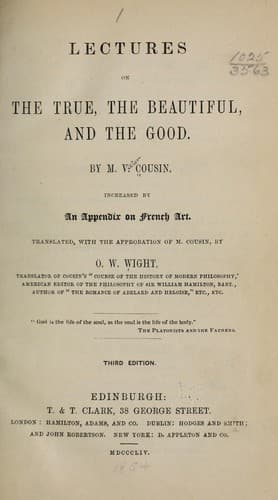
Lectures on the true, the beautiful and the goodCousin, Victor
Philosophy
Lectures on the true, the beautiful and the good
Cousin, Victor
Aesthetics; Ethics; Truth
A celebrated and very ancient[104] theory makes the beautiful consist in
the perfect suitableness of means to their end. Here the beautiful is no
longer the useful, it is the suitable; these two ideas must be
distinguished. A machine produces excellent effects, economy of time,
work, etc.; it is therefore useful. If, moreover, examining its
construction, I find that each piece is in its place, and that all are
skilfully disposed for the result which they should produce; even
without regarding the utility of this result, as the means are well
adapted to their end, I judge that there is suitableness in it. We are
already approaching the idea of the beautiful; for we are no longer
considering what is useful, but what is proper. Now, we have not yet
attained the true character of beauty; there are, in fact, objects very
well adapted to their end, which we do not call beautiful. A bench
without ornament and without elegance, provided it be solid, provided
all the parts are firmly connected, provided one may sit down on it with
safety, provided it may be for this purpose suitable, agreeable even,
may give an example of the most perfect adaptation of means to an end;
it will not, therefore, be said that this bench is beautiful. There is
here always this difference between suitableness and utility, that an
object to be beautiful has no need of being useful, but that it is not
beautiful if it does not possess suitableness, if there is in it a
disagreement between the end and the means.
Some have thought to find the beautiful in proportion, and this is, in
fact, one of the conditions of beauty, but it is not the only one. It is
very certain, that an object ill-proportioned cannot be beautiful. There
is in all beautiful objects, however far they may be from geometric
form, a sort of living geometry. But, I ask, is it proportion that is
dominant in this slender tree, with flexible and graceful branches, with
rich and shady foliage? What makes the terrible beauty of a storm, what
makes that of a great picture, of an isolated verse, or a sublime ode?
It is not, I know, wanting in law and rule, neither is it law and rule:
often, even what at first strikes us is an apparent irregularity. It is
absurd to pretend that what makes us admire all these things and many
more, is the same quality that makes us admire a geometric figure, that
is to say, the exact correspondence of parts.
What we say of proportion may be said of order, which is something less
mathematical than proportion, but scarcely explains better what is
free, varied, and negligent in certain beauties.
All these theories which refer beauty to order, harmony, and proportion,
are at foundation only one and the same theory which in the beautiful
sees unity before all. And surely unity is beautiful; it is an important
part of beauty, but it is not the whole of beauty.
Public-domain text, read in full here on John Shaqi.
Reviews
Reviews
No reviews yet
Be the first to share your thoughts on this work.
Elsewhere in the archive
Join the Discussion
Join the discussion
Sign in to leave a comment or review.
Sign InorCreate an account