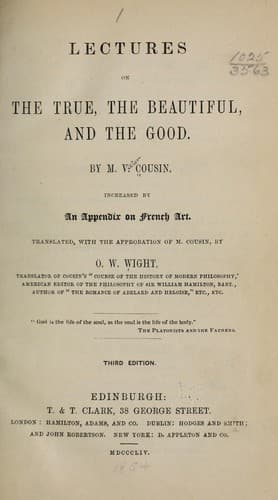
Lectures on the true, the beautiful and the goodCousin, Victor
Philosophy
Lectures on the true, the beautiful and the good
Cousin, Victor
Aesthetics; Ethics; Truth
Two extremes are equally dangerous--a lifeless ideal, or the absence of
the ideal. Either we copy the model, and are wanting in true beauty, or
we work _de tete_, and fall into an ideality without character. Genius
is a ready and sure perception of the right proportion in which the
ideal and the natural, form and thought, ought to be united. This union
is the perfection of art: _chefs-d'oeuvre_ are produced by observing
it.
It is important, in my opinion, to follow this rule in teaching art. It
is asked whether pupils should begin with the study of the ideal or the
real. I do not hesitate to answer,--by both. Nature herself never offers
the general without the individual, nor the individual without the
general. Every figure is composed of individual traits which distinguish
it from all others, and make its own looks, and, at the same time, it
has general traits which constitute what is called the human figure.
These general traits are the constitutive lineaments, and this figure is
the type, that are given to the pupil that is beginning in the art of
design to trace. It would also be good, I believe, in order to preserve
him from the dry and abstract, to exercise him early in copying some
natural object, especially a living figure. This would be putting pupils
to the true school of nature. They would thus become accustomed never to
sacrifice either of the two essential elements of the beautiful, either
of the two imperative conditions of art.
But, in uniting these two elements, these two conditions, it is
necessary to distinguish them, and to know how to put them in their
place. There is no true ideal without determinate form, there is no
unity without variety, no genus without individuals, but, in fine, the
foundation of the beautiful is the idea; what makes art is before all,
the realization of the idea, and not the imitation of such or such a
particular form.
Public-domain text, read in full here on John Shaqi.
Reviews
Reviews
No reviews yet
Be the first to share your thoughts on this work.
Elsewhere in the archive
Join the Discussion
Join the discussion
Sign in to leave a comment or review.
Sign InorCreate an account