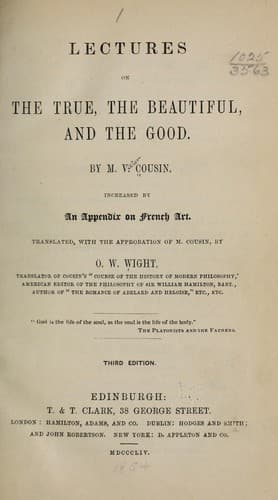
Lectures on the true, the beautiful and the goodCousin, Victor
Philosophy
Lectures on the true, the beautiful and the good
Cousin, Victor
Aesthetics; Ethics; Truth
At the commencement of our century, the Institute of France offered a
prize for the best answer to the following question: _What were the
causes of the perfection of the antique sculpture, and what would be the
best means of attaining it?_ The successful competitor, M. Emeric
David,[112] maintained the opinion then dominant, that the assiduous
study of natural beauty had alone conducted the antique art to
perfection, and that thus the imitation of nature was the only route to
reach the same perfection. A man whom I do not fear to compare with
Winkelmann, the future author of the _Olympic Jupiter_,[113] M.
Quatremere de Quincy, in some ingenious and profound disquisitions,[114]
combated the doctrine of the laureate, and defended the cause of ideal
beauty. It is impossible to demonstrate more decidedly, by the entire
history of Greek sculpture, and by authentic texts from the greatest
critiques of antiquity, that the process of art among the Greeks was
not the imitation of nature, either by a particular model, or by
several, the most beautiful model being always very imperfect, and
several models not being able to compose a single beauty. The true
process of the Greek art was the representation of an ideal beauty which
nature scarcely possessed more in Greece than among us, which it could
not then offer to the artist. We regret that the honorable laureate,
since become a member of the Institute, pretended that this expression
of ideal beauty, if it had been known by the Greeks, would have meant
_visible beauty_, because ideal comes from [Greek: eidos], which
signifies only, according to M. Emeric David, a form seen by the eye.
Plato would have been much surprised at this exclusive interpretation of
the word [Greek: eidos]. M. Quatremere de Quincy confounds his unequal
adversary by two admirable texts, one from the _Timaeus_, where Plato
marks with precision in what the true artist is superior to the ordinary
artist, the other at the commencement of the _Orator_, where Cicero
explains the manner in which great artists work, in referring to the
manner of Phidias, that is to say, the most perfect master of the most
perfect epoch of art.
"The artist,[115] who, with eye fixed upon the immutable being, and
using such a model, reproduces its idea and its excellence, cannot fail
to produce a whole whose beauty is complete, whilst he who fixes his eye
upon what is transitory, with this perishable model will make nothing
beautiful."
"Phidias,[116] that great artist, when he made the form of Jupiter or
Minerva, did not contemplate a model a resemblance of which he would
express; but in the depth of his soul resided a perfect type of beauty,
upon which he fixed his look, which guided his hand and his art."
Public-domain text, read in full here on John Shaqi.
Reviews
Reviews
No reviews yet
Be the first to share your thoughts on this work.
Elsewhere in the archive
Join the Discussion
Join the discussion
Sign in to leave a comment or review.
Sign InorCreate an account