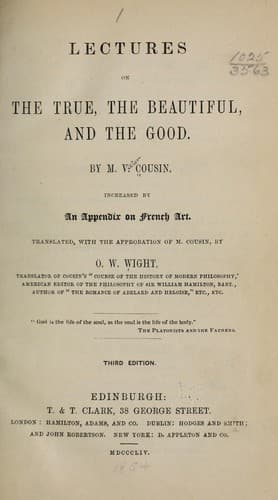
Lectures on the true, the beautiful and the goodCousin, Victor
Philosophy
Lectures on the true, the beautiful and the good
Cousin, Victor
Aesthetics; Ethics; Truth
Is not this process of Phidias precisely that which Raphael describes
in the famous letter to Castiglione, which he declares that he followed
himself for the Galatea?[117] "As," he says, "I am destitute of
beautiful models, I use a certain ideal which I form for myself."
There is another theory which comes back, by a circuit, to imitation: it
is that which makes illusion the end of art. If this theory be true, the
ideal beauty of painting is a _tromp-l'oeil_,[118] and its
master-piece is the grapes of Zeuxis that the birds came and pecked at.
The height of art in a theatrical piece would be to persuade you that
you are in the presence of reality. What is true in this opinion is,
that a work of art is beautiful only on the condition of being
life-like, and, for example, the law of dramatic art is not to put on
the stage pale phantoms of the past, but personages borrowed from
imagination or history, as you like, but animated, endowed with passion,
speaking and acting like men and not like shades. It is human nature
that is to be represented to itself under a magic light that does not
disfigure it, but ennobles it. This magic is the very genius of art. It
lifts us above the miseries that besiege us, and transports us to
regions where we still find ourselves, for we never wish to lose sight
of ourselves, but where we find ourselves transformed to our advantage,
where all the imperfections of reality have given place to a certain
perfection, where the language that we speak is more equal and elevated,
where persons are more beautiful, where the ugly is not admitted, and
all this while duly respecting history, especially without ever going
beyond the imperative conditions of human nature. Has art forgotten
human nature? it has passed beyond its end, it has not attained it; it
has brought forth nothing but chimeras without interest for our soul.
Has it been too human, too real, too nude? it has fallen short of its
end; it has then attained it no better.
Public-domain text, read in full here on John Shaqi.
Reviews
Reviews
No reviews yet
Be the first to share your thoughts on this work.
Elsewhere in the archive
Join the Discussion
Join the discussion
Sign in to leave a comment or review.
Sign InorCreate an account