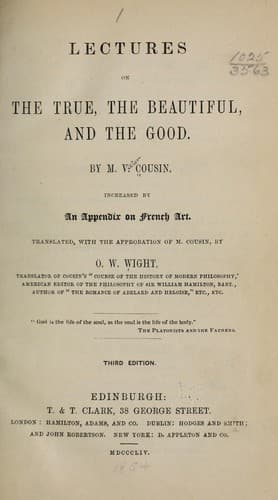
Lectures on the true, the beautiful and the goodCousin, Victor
Philosophy
Lectures on the true, the beautiful and the good
Cousin, Victor
Aesthetics; Ethics; Truth
Illusion is so little the end of art, that it may be complete and have
no charm. Thus, in the interest of illusion, theatrical men have taken
great pains in these latter times to secure historical accuracy of
costume. This is all very well; but it is not the most important thing.
Had you found, and lent to the actor who plays the part of Brutus, the
very costume that of old the Roman hero wore, it would touch true
connoisseurs very little. This is not all; when the illusion goes too
far, the sentiment of art disappears in order to give place to a
sentiment purely natural, sometimes insupportable. If I believed that
Iphegenia were in fact on the point of being immolated by her father at
a distance of twenty paces from me, I should leave the theatre trembling
with horror. If the Ariadne that I see and hear, were the true Ariadne
who is about to be betrayed by her sister, in that pathetic scene where
the poor woman, who already feels herself less loved, asks who then robs
her of the heart, once so tender, of Theseus, I would do as the young
Englishman did, who cried out, sobbing and trying to spring upon the
stage, "It is Phedre, it is Phedre!" as if he would warn and save
Ariadne.
But, it is said, is it not the aim of the poet to excite pity and
terror? Yes; but at first in a certain measure; then he must mix with
them some other sentiment that tempers them, or makes them serve another
end. If the aim of dramatic art were only to excite in the highest
degree pity and terror, art would be the powerless rival of nature. All
the misfortunes represented on the stage are very feeble in comparison
with those sad spectacles which we may see every day. The first hospital
is fuller of pity and terror than all the theatres in the world. What
should the poet do in the theory that we combat? He should transfer to
the stage the greatest possible reality, and move us powerfully by
shocking our senses with the sight of frightful pains. The great resort
of the pathetic would then be the representation of death, especially
that of the greatest torture. Quite on the contrary, there is an end of
art when sensibility is too much excited. To take, again, an example
that we have already employed, what constitutes the beauty of a
tempest, of a shipwreck? What attracts us to those great scenes of
nature? It is certainly not pity and terror,--these poignant and
lacerating sentiments would much sooner keep us away. An emotion very
different from these is necessary, which triumphs over us, in order to
retain us by the shore; this emotion is the pure sentiment of the
beautiful and the sublime, excited and kept alive by the grandeur of the
spectacle, by the vast extent of the sea, the rolling of the foaming
waves, and the imposing sound of the thunder. But do we think for a
single instant that there are in the midst of the sea the unfortunate
who are suffering, and are, perhaps, about to perish? From that moment
the spectacle becomes to us insupportable. It is so in art.
Public-domain text, read in full here on John Shaqi.
Reviews
Reviews
No reviews yet
Be the first to share your thoughts on this work.
Elsewhere in the archive
Join the Discussion
Join the discussion
Sign in to leave a comment or review.
Sign InorCreate an account