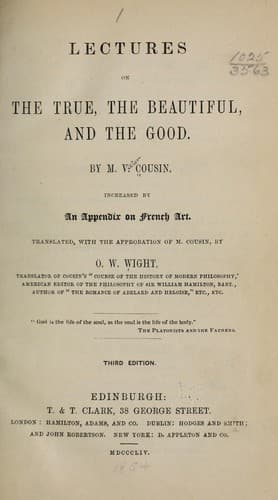
Lectures on the true, the beautiful and the goodCousin, Victor
Philosophy
Lectures on the true, the beautiful and the good
Cousin, Victor
Aesthetics; Ethics; Truth
Whatever
sentiment it proposes to excite in us, must always be tempered and
governed by that of the beautiful. If it only produces pity or terror
beyond a certain limit, especially physical pity or terror, it revolts,
and no longer charms; it loses the effect that belongs to it in exchange
for a foreign and vulgar effect.
For this same reason, I cannot accept another theory, which, confounding
the sentiment of the beautiful with the moral and religious sentiment,
puts art in the service of religion and morals, and gives it for its end
to make us better and elevate us to God. There is here an essential
distinction to be made. If all beauty covers a moral beauty, if the
ideal mounts unceasingly towards the infinite, art, which expresses
ideal beauty, purifies the soul in elevating it towards the infinite,
that is to say, towards God. Art, then, produces the perfection of the
soul, but it produces it indirectly. The philosopher who investigates
effects and causes, knows what is the ultimate principle of the
beautiful and its certain, although remote, effects. But the artist is
before all things an artist; what animates him is the sentiment of the
beautiful; what he wishes to make pass into the soul of the spectator is
the same sentiment that fills his own. He confides himself to the virtue
of beauty; he fortifies it with all the power, all the charm of the
ideal; it must then do its own work; the artist has done his when he
has procured for some noble souls the exquisite sentiment of beauty.
This pure and disinterested sentiment is a noble ally of the moral and
religious sentiments; it awakens, preserves, and develops them, but it
is a distinct and special sentiment. So art, which is founded on this
sentiment, which is inspired by it, which expands it, is in its turn an
independent power. It is naturally associated with all that ennobles the
soul, with morals and religion; but it springs only from itself.
Let us confine our thought strictly within its proper limits. In
vindicating the independence, the proper dignity, and the particular end
of art, we do not intend to separate it from religion, from morals, from
country. Art draws its inspirations from these profound sources, as well
as from the ever open source of nature. But it is not less true that
art, the state, religion, are powers which have each their world apart
and their own effects; they mutually help each other; they should not
serve each other. As soon as one of them wanders from its end, it errs,
and is degraded. Does art blindly give itself up to the orders of
religion and the state? In losing its liberty, it loses its charm and
its empire.
Public-domain text, read in full here on John Shaqi.
Reviews
Reviews
No reviews yet
Be the first to share your thoughts on this work.
Elsewhere in the archive
Join the Discussion
Join the discussion
Sign in to leave a comment or review.
Sign InorCreate an account