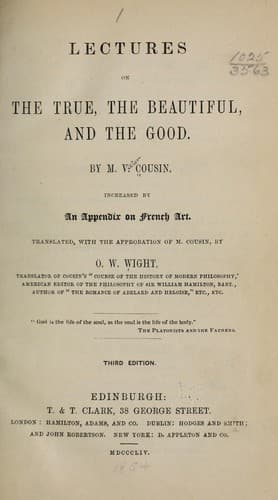
Lectures on the true, the beautiful and the goodCousin, Victor
Philosophy
Lectures on the true, the beautiful and the good
Cousin, Victor
Aesthetics; Ethics; Truth
Ancient Greece and modern Italy are continually cited as triumphant
examples of what the alliance of art, religion, and the state can do.
Nothing is more true, if the question is concerning their union; nothing
is more false, if the question is concerning the servitude of art. Art
in Greece was so little the slave of religion, that it little by little
modified the symbols, and, to a certain extent, the spirit itself, by
its free representations. There is a long distance between the
divinities that Greece received from Egypt and those of which it has
left immortal exemplars. Are those primitive artists and poets, as Homer
and Dedalus are called, strangers to this change? And in the most
beautiful epoch of art, did not AEschylus and Phidias carry a great
liberty into the religious scenes which they exposed to the gaze of the
people, in the theatre, or in front of the temples? In Italy as in
Greece, as everywhere, art is at first in the hands of priesthoods and
governments; but, as it increases its importance and is developed, it
more and more conquers its liberty. Men speak of the faith that animated
the artists and vivified their works; that is true of the time of Giotto
and Ciambue; but after Angelico de Fiesole, at the end of the fifteenth
century, in Italy, I perceive especially the faith of art in itself and
the worship of beauty. Raphael was about to become a cardinal;[119] yes,
but always painting Galatea, and without quitting Fornarine. Once more,
let us exaggerate nothing; let us distinguish, not separate; let us
unite art, religion, and country, but let not their union injure the
liberty of each. Let us be thoroughly penetrated with the thought, that
art is also to itself a kind of religion. God manifests himself to us by
the idea of the true, by the idea of the good, by the idea of the
beautiful. Each one of them leads to God, because it comes from him.
True beauty is ideal beauty, and ideal beauty is a reflection of the
infinite. So, independently of all official alliance with religion and
morals, art is by itself essentially religious and moral; for, far from
wanting its own law, its own genius, it everywhere expresses in its
works eternal beauty. Bound on all sides to matter by inflexible laws,
working upon inanimate stone, upon uncertain and fugitive sounds, upon
words of limited and finite signification, art communicates to them,
with the precise form that is addressed to such or such a sense, a
mysterious character that is addressed to the imagination and the soul,
takes them away from reality, and bears them sweetly or violently into
unknown regions. Every work of art, whatever may be its form, small or
great, figured, sung, or uttered,--every work of art, truly beautiful or
sublime, throws the soul into a gentle or severe reverie that elevates
it towards the infinite. The infinite is the common limit after which
the soul aspires upon the wings of imagination as well as reason, by the
Public-domain text, read in full here on John Shaqi.
Reviews
Reviews
No reviews yet
Be the first to share your thoughts on this work.
Elsewhere in the archive
Join the Discussion
Join the discussion
Sign in to leave a comment or review.
Sign InorCreate an account