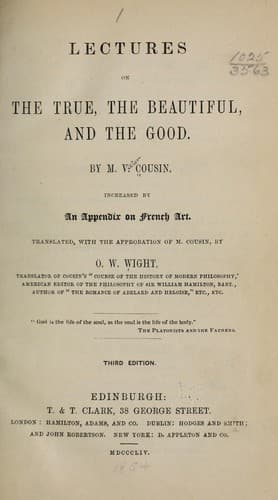
Lectures on the true, the beautiful and the goodCousin, Victor
Philosophy
Lectures on the true, the beautiful and the good
Cousin, Victor
Aesthetics; Ethics; Truth
Similar by their common end, all the arts differ by the particular
effects which they produce, and by the processes which they employ. They
gain nothing by exchanging their means and confounding the limits that
separate them. I bow before the authority of antiquity; but, perhaps,
through habit and a remnant of prejudice, I have some difficulty in
representing to myself with pleasure statues composed of several metals,
especially painted statues.[123] Without pretending that sculpture has
not to a certain point its color, that of perfectly pure matter, that
especially which the hand of time impresses upon it, in spite of all the
seductions of a contemporaneous[124] artist of great talent, I have
little taste, I confess, for that artifice that is forced to give to
marble the _morbidezza_ of painting. Sculpture is an austere muse; it
has its graces, but they are those of no other art. Flesh-color must
remain a stranger to it: there would nothing more remain to communicate
to it but the movement of poetry and the indefiniteness of music! And
what will music gain by aiming at the picturesque, when its proper
domain is the pathetic? Give to the most learned symphonist a storm to
render. Nothing is easier to imitate than the whistling of the winds and
the noise of thunder. But by what combinations of harmony will he
exhibit to the eyes the glare of the lightning rending all of a sudden
the veil of the night, and what is most fearful in the tempest, the
movement of the waves that now ascend like a mountain, now descend and
seem to precipitate themselves into bottomless abysses? If the auditor
is not informed of the subject, he will never suspect it, and I defy him
to distinguish a tempest from a battle. In spite of science and genius,
sounds cannot paint forms. Music, when well guided, will guard itself
from contending against the impossible; it will not undertake to express
the tumult and strife of the waves and other similar phenomena; it will
do more: with sounds it will fill the soul with the sentiments that
succeed each other in us during the different scenes of the tempest.
Haydn will thus become[125] the rival, even the vanquisher of the
painter, because it has been given to music to move and agitate the soul
more profoundly than painting.
Since the _Laocoon_ of Lessing, it is no longer permitted to repeat,
without great reserve, the famous axiom,--_Ut pictura poesis_; or, at
least, it is very certain that painting cannot do every thing that
poetry can do. Everybody admires the picture of Rumor, drawn by Virgil;
but let a painter try to realize this symbolic figure; let him represent
to us a huge monster with a hundred eyes, a hundred mouths, and a
hundred ears, whose feet touch the earth, whose head is lost in the
clouds, and such a figure will become very ridiculous.
Public-domain text, read in full here on John Shaqi.
Reviews
Reviews
No reviews yet
Be the first to share your thoughts on this work.
Elsewhere in the archive
Join the Discussion
Join the discussion
Sign in to leave a comment or review.
Sign InorCreate an account