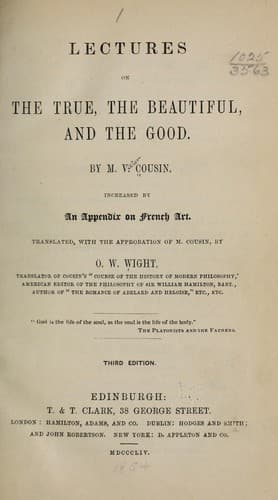
Lectures on the true, the beautiful and the goodCousin, Victor
Philosophy
Lectures on the true, the beautiful and the good
Cousin, Victor
Aesthetics; Ethics; Truth
So the arts have a common end, and entirely different means. Hence the
general rules common to all, and particular rules for each. I have
neither time nor space to enter into details on this point. I limit
myself to repeating, that the great law which governs all others, is
expression. Every work of art that does not express an idea signifies
nothing; in addressing itself to such or such a sense, it must penetrate
to the mind, to the soul, and bear thither a thought, a sentiment
capable of touching or elevating it. From this fundamental rule all the
others are derived; for example, that which is continually and justly
recommended,--composition. To this is particularly applied the precept
of unity and variety. But, in saying this, we have said nothing so long
as we have not determined the nature of the unity of which we would
speak. True unity, is unity of expression, and variety is made only to
spread over the entire work the idea or the single sentiment that it
should express. It is useless to remark, that between composition thus
defined, and what is often called composition, as the symmetry and
arrangement of parts according to artificial rules, there is an abyss.
True composition is nothing else than the most powerful means of
expression.
Expression not only furnishes the general rules of art, it also gives
the principle that allows of their classification.
In fact, every classification, supposes a principle that serves as a
common measure.
Such a principle has been sought in pleasure, and the first of arts has
seemed that which gives the most vivid joys. But we have proved that the
object of art is not pleasure:--the more or less of pleasure that an art
procures cannot, then, be the true measure of its value.
This measure is nothing else than expression. Expression being the
supreme end, the art that most nearly approaches it is the first of all.
All true arts are expressive, but they are diversely so. Take music; it
is without contradiction the most penetrating, the profoundest, the most
intimate art. There is physically and morally between a sound and the
soul a marvellous relation. It seems as though the soul were an echo in
which the sound takes a new power. Extraordinary things are recounted of
the ancient music. And it must not be believed that the greatness of
effect supposes here very complicated means. No, the less noise music
makes, the more it touches. Give some notes to Pergolese, give him
especially some pure and sweet voices, and he returns a celestial charm,
bears you away into infinite spaces, plunges you into ineffable
reveries. The peculiar power of music is to open to the imagination a
limitless career, to lend itself with astonishing facility to all the
moods of each one, to arouse or calm, with the sounds of the simplest
melody, our accustomed sentiments, our favorite affections. In this
respect music is an art without a rival:--however, it is not the first
of arts.
Public-domain text, read in full here on John Shaqi.
Reviews
Reviews
No reviews yet
Be the first to share your thoughts on this work.
Elsewhere in the archive
Join the Discussion
Join the discussion
Sign in to leave a comment or review.
Sign InorCreate an account