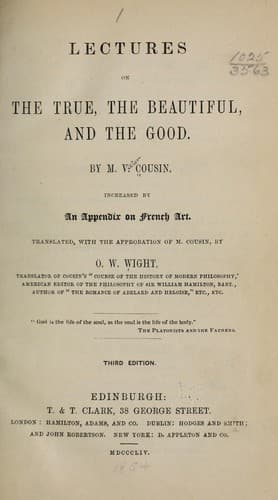
Lectures on the true, the beautiful and the goodCousin, Victor
Philosophy
Lectures on the true, the beautiful and the good
Cousin, Victor
Aesthetics; Ethics; Truth
Music pays for the immense power that has been given it; it awakens more
than any other art the sentiment of the infinite, because it is vague,
obscure, indeterminate in its effects. It is just the opposite art to
sculpture, which bears less towards the infinite, because every thing in
it is fixed with the last degree of precision. Such is the force and at
the same time the feebleness of music, that it expresses every thing and
expresses nothing in particular. Sculpture, on the contrary, scarcely
gives rise to any reverie, for it clearly represents such a thing and
not such another. Music does not paint, it touches; it puts in motion
imagination, not the imagination that reproduces images, but that which
makes the heart beat, for it is absurd to limit imagination to the
domain of images.[126] The heart, once touched, moves all the rest of
our being; thus music, indirectly, and to a certain point, can recall
images and ideas; but its direct and natural power is neither on the
representative imagination nor intelligence, it is on the heart, and
that is an advantage sufficiently beautiful.
The domain of music is sentiment, but even there its power is more
profound than extensive, and if it expresses certain sentiments with an
incomparable force, it expresses but a very small number of them. By way
of association, it can awaken them all, but directly it produces very
few of them, and the simplest and the most elementary, too,--sadness and
joy with their thousand shades. Ask music to express magnanimity,
virtuous resolution, and other sentiments of this kind, and it will be
just as incapable of doing it, as of painting a lake or a mountain. It
goes about it as it can; it employs the slow, the rapid, the loud, the
soft, etc., but imagination has to do the rest, and imagination does
only what it pleases. The same measure reminds one of a mountain,
another of the ocean; the warrior finds in it heroic inspirations, the
recluse religious inspirations. Doubtless, words determine musical
expression, but the merit then is in the word, not in the music; and
sometimes the word stamps the music with a precision that destroys it,
and deprives it of its proper effects--vagueness, obscurity, monotony,
but also fulness and profundity, I was about to say infinitude. I do not
in the least admit that famous definition of song:--a noted declamation.
A simple declamation rightly accented is certainly preferable to
stunning accompaniments; but to music must be left its character, and
its defects and advantages must not be taken away from it. Especially it
must not be turned aside from its object, and there must not be demanded
from it what it could not give. It is not made to express complicated
and factitious sentiment, nor terrestrial and vulgar sentiments. Its
peculiar charm is to elevate the soul towards the infinite. It is
therefore naturally allied to religion, especially to that religion of
the infinite, which is at the same time the religion of the heart; it
Public-domain text, read in full here on John Shaqi.
Reviews
Reviews
No reviews yet
Be the first to share your thoughts on this work.
Elsewhere in the archive
Join the Discussion
Join the discussion
Sign in to leave a comment or review.
Sign InorCreate an account