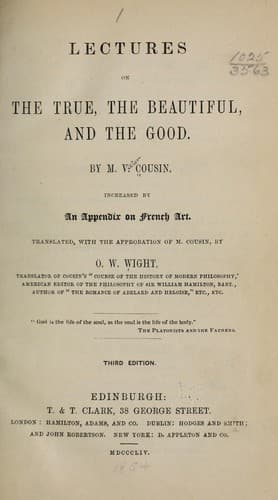
Lectures on the true, the beautiful and the goodCousin, Victor
Philosophy
Lectures on the true, the beautiful and the good
Cousin, Victor
Aesthetics; Ethics; Truth
What other time, at least among the moderns, has seen flourishing
together so many poets of the first order? We have, it is true, neither
Homer, nor Dante, nor Milton, nor even Tasso. The epic, with its
primitive simplicity, is interdicted us. But in the drama we scarcely
have equals. It is because dramatic poetry is the poetry that is adapted
to us, moral poetry _par excellence_, which represents man with his
different passions armed against each other, the violent contentions
between virtue and crime, the freaks of fortune, the lessons of
providence, and in a narrow compass, too, in which the events press upon
each other without confusion, in which the action rapidly progresses
towards the crisis that must reveal what is most intimate to the heart
of the personages.
Let us dare to say what we think, that, in our opinion, AEschylus,
Sophocles, and Euripides, together, do not equal Corneille; for none of
them has known and expressed like him what is of all things most truly
touching, a great soul at war with itself, between a generous passion
and duty. Corneille is the creator of a new pathetic unknown to
antiquity and to all the moderns before him. He disdains to address
common and subaltern passions; he does not seek to rouse terror and
pity, as demands Aristotle, who limits himself to erecting into maxims
the practice of the Greeks. Corneille seems to have read Plato, and
followed his precepts:--he addresses a most elevated part of human
nature, the noblest passion, the one nearest virtue,--admiration; and
from admiration carried to its culmination he draws the most powerful
effects. Shakspeare, we admit, is superior to Corneille in extent and
richness of dramatic genius. Entire human nature seems at his disposal,
and he reproduces the different scenes of life in their beauty and
deformity, in their grandeur and baseness. He excels in painting the
terrible or the gentle passions. Othello is jealousy, Lady Macbeth is
ambition, as Juliet and Desdemona are the immortal names of youthful and
unfortunate love. But if Corneille has less imagination, he has more
soul. Less varied, he is more profound. If he does not put upon the
stage so many different characters, those that he does put on it are the
greatest that can be offered to humanity. The scenes that he gives are
less heart-rending, but at once more delicate and more sublime. What is
the melancholy of Hamlet, the grief of King Lear, even the disdainful
intrepidity of Caesar, in comparison with the magnanimity of Augustus
striving to be master of himself as well as the universe, in comparison
with Chimene sacrificing love to honor, especially in comparison with
Pauline, not suffering even at the bottom of her heart an involuntary
sigh for the one that she must not love? Corneille always confines
himself to the highest regions. He is by turns Roman and Christian. He
is the interpreter of heroes, the chanter of virtue, the poet of
Public-domain text, read in full here on John Shaqi.
Reviews
Reviews
No reviews yet
Be the first to share your thoughts on this work.
Elsewhere in the archive
Join the Discussion
Join the discussion
Sign in to leave a comment or review.
Sign InorCreate an account