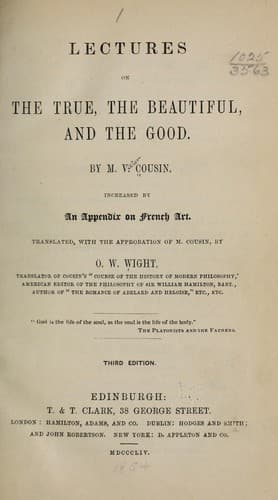
Lectures on the true, the beautiful and the goodCousin, Victor
Philosophy
Lectures on the true, the beautiful and the good
Cousin, Victor
Aesthetics; Ethics; Truth
warriors and politicians.[128] And it must not be forgotten that
Shakspeare is almost alone in his times, whilst after Corneille comes
Racine, who would suffice for the poetical glory of a nation.
Racine assuredly cannot be compared with Corneille for dramatic genius;
he is more the man of letters; he has not the tragic soul; he neither
loves nor understands politics and war. When he imitates Corneille, for
example, in Alexander, and even in Mithridates, he imitates him badly
enough. The scene, so vaunted, of Mithridates exposing his plan of
campaign to his sons is a morsel of the finest rhetoric, which cannot be
compared with the political and military scenes of Cinna and Sertorius,
especially with that first scene of the Death of Pompey, in which you
witness a counsel as true, as grand, as profound as ever could have been
one of the counsels of Richelieu or Mazarin. Racine was not born to
paint heroes, but he paints admirably man with his natural passions, and
the most natural as well as the most touching of all, love. So he
particularly excels in feminine characters. For men he has need of being
sustained by Tacitus or holy Scripture.[129] With woman he is at his
ease, and he makes them think and speak with perfect truth, set off by
exquisite art. Demand of him neither Emilie, Cornelie, nor Pauline; but
listen to Andromaque, Monime, Berenice, and Phedre! There, even in
imitating, he is original, and leaves the ancients very far behind him.
Who has taught him that charming delivery, those graceful troubles, that
purity even in feebleness, that melancholy, sometimes even that depth,
with that marvellous language which seems the natural accent of woman's
heart? It is continually repeated that Racine wrote better than
Corneille:--say only that the two wrote very differently, and like men
in very different epochs. One has two sovereign qualities, which belong
to his own nature and his times, a _naivete_ and grandeur, the other is
not _naive_, but he has too much taste not to be always simple, and he
supplies the place of grandeur, forever lost, with consummate elegance.
Corneille speaks the language of statesmen, soldiers, theologians,
philosophers, and clever women; of Richelieu, Rohan, Saint-Cyran,
Descartes, and Pascal; of mother Angelique Arnaud and mother Madeleine
de Saint-Joseph; the language which Moliere still spoke, which Bossuet
preserved to his last breath. Racine speaks that of Louis XIV. and the
women who were the ornament of his court. I suppose that thus spoke
Madame, the amiable, sprightly, and unfortunate Henriette; thus wrote
the author of the _Princesse de Cleves_ and the author of _Telemaque_.
Or, rather, this language is that of Racine himself, of that feeble and
tender soul, which passed quickly from love to devotion, which uttered
its complaints in lyric poetry, which was wholly poured out in the
choruses of _Esther_ and _Athalie_, and in the _Cantiques Spirituels_;
Public-domain text, read in full here on John Shaqi.
Reviews
Reviews
No reviews yet
Be the first to share your thoughts on this work.
Elsewhere in the archive
Join the Discussion
Join the discussion
Sign in to leave a comment or review.
Sign InorCreate an account