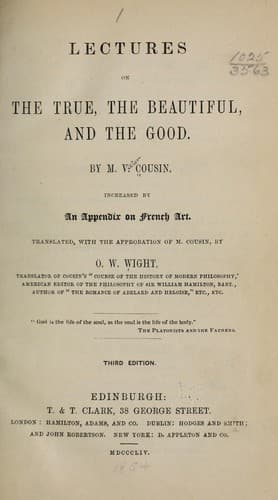
Lectures on the true, the beautiful and the goodCousin, Victor
Philosophy
Lectures on the true, the beautiful and the good
Cousin, Victor
Aesthetics; Ethics; Truth
that soul, so easy to be moved, that a religious ceremony or a
representation of _Esther_ at Saint-Cyr touched to tears, that pitied
the misfortunes of the people, that found in its pity and its charity
the courage to speak one day the truth to Louis XIV., and was
extinguished by the first breath of disgrace.
Moliere is, in comparison with Aristophanes, what Corneille is, in
comparison with Shakspeare. The author of _Plutus_, the _Wasps_, and the
_Clouds_, has doubtless an imagination, an explosive buffoonery, a
creative power, above all comparison. Moliere has not as great poetical
conceptions: he has more, perhaps; he has characters. His coloring is
less brilliant, his graver is more penetrating. He has engraved in the
memory of men a certain number of irregularities and vices which will
ever be called _l'Avare_ (_the Miser_), _le Malade Imaginaire_ (the
_Hypochondriac_), _les Femmes Savantes_ (the _Learned Women_), _le
Tartufe_ (the _Hypocrite_), and _Don Juan_, not to speak of the
_Misanthrope_, a piece apart, touching as pleasant, which is not
addressed to the crowd, and cannot be popular, because it expresses a
ridicule rare enough, excess in the passion of truth and honor.
Of all fabulists, ancient and modern, does any one, even the ingenious,
the pure, the elegant Phaedrus, approach our La Fontaine? He composes his
personages, and puts them in action with the skill of Moliere; he knows
how to take on occasion the tone of Horace, and mingle an ode with a
fable; he is at once the most naive, and the most refined of writers,
and his art disappears in its very perfection. We do not speak of the
tales, first, because we condemn the kind, then, because La Fontaine
displays in them qualities more Italian than French, a narrative full of
nature, malice, and grace, but without any of those profound, tender,
melancholy traits, that place among the greatest poets of all time the
author of the _Two Pigeons_ (_Deux Pigeons_), the _Old Man_
(_Vieillard_), and the _Three Young Persons_ (_Gens_).
Public-domain text, read in full here on John Shaqi.
Reviews
Reviews
No reviews yet
Be the first to share your thoughts on this work.
Elsewhere in the archive
Join the Discussion
Join the discussion
Sign in to leave a comment or review.
Sign InorCreate an account