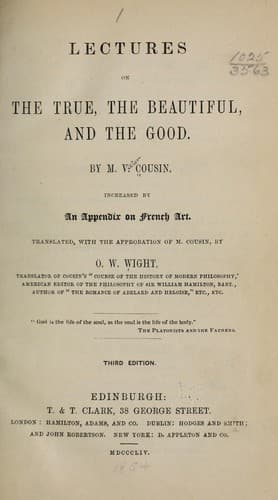
Lectures on the true, the beautiful and the goodCousin, Victor
Philosophy
Lectures on the true, the beautiful and the good
Cousin, Victor
Aesthetics; Ethics; Truth
We do not hesitate to put Boileau among these great men. He comes after
them, it is true, but he belongs to their company: he comprehends them,
loves them, sustains them. It was he, who, in 1663, after the _School of
Women_ (_l'Ecole des Femmes_) and long before the _Hypocrite_ (_le
Tartufe_), and the _Misanthrope_, proclaimed Moliere the master in the
art of verse. It was he who, in 1677, after the failure of _Phedre_,
defended the vanquisher of Euripides against the successes of Pradon. It
was he who, in advance of posterity, first put in light what is new and
entirely original in the plays of Corneille.[130] He saved the pension
of the old tragedian by offering the sacrifice of his own. Louis XIV.
asking him what writer most honored his reign, Boileau answered, that it
was Moliere; and when the great king in his decline persecuted
Port-Royal, and wished to lay hands on Arnaud, he encountered a man of
letters, who said to the face of the imperious monarch,--"Your Majesty
in vain seeks M. Arnaud, you are too fortunate to find him." Boileau is
somewhat wanting in imagination and invention; but he is great in the
energetic sentiment of truth and justice; he carries to the extent of
passion taste for the beautiful and the honest; he is a poet by force
of soul and good sense. More than once his heart dictated to him the
most pathetic verses:
"In vain against the Cid a minister is leagued,[131]
All Paris for Chimene the eyes of Rodrique," etc.
* * * * *
"After a little spot of earth, obtained by prayer,
Forever in the tomb had inclosed Moliere," etc.
And this epitaph of Arnaud, so simple and so grand:[132]
"At the feet of this altar of structure gross,
Lies without pomp, inclosed in a coffin vile,
The most learned mortal that ever wrote;
Arnaud, who in grace instructed by Jesus Christ,
Combating for the Church, has, in the Church itself,
Suffered more than one outrage and more than one anathema," etc.
* * * * *
"Wandering, poor, banished, proscribed, persecuted;
And even by his death their ill-extinguished rage
Had never left his ashes in repose,
If God himself here by his holy flock
From these devouring wolves had not concealed his bones."[133]
These are, I think, poets sufficiently great, and we have more of them
still: I mean those charming or sublime minds who have elevated prose
to poetry. Greece alone, in her most beautiful days, offers, perhaps,
such a variety of admirable prose writers. Who can enumerate them? At
first, Rabelais and Montaigne; later, Descartes, Pascal, and
Malebranche; La Rochefoucauld and La Bruyere; Retz and Saint-Simon;
Bourdaloue, Flechier, Fenelon, and Bossuet; add to these so many eminent
women, at their head Madame de Sevigne; while Montesquieu, Voltaire,
Rousseau, and Buffon are still to come.[134]
Public-domain text, read in full here on John Shaqi.
Reviews
Reviews
No reviews yet
Be the first to share your thoughts on this work.
Elsewhere in the archive
Join the Discussion
Join the discussion
Sign in to leave a comment or review.
Sign InorCreate an account