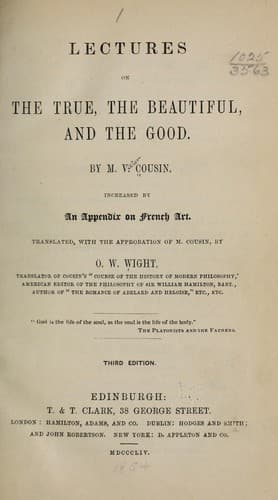
Lectures on the true, the beautiful and the goodCousin, Victor
Philosophy
Lectures on the true, the beautiful and the good
Cousin, Victor
Aesthetics; Ethics; Truth
Here, perhaps, some disciple of Condillac and Helvetius will ask us
whether, in this regard, we possess authentic dictionaries of the
language of savage tribes found by voyagers in the isles of the ocean?
No; but we have not made our philosophic religion out of the
superstitions and prejudices of a certain school. We absolutely deny
that it is necessary to study human nature in the famous savage of
Aveyron, or in the like of him of the isles of the ocean, or the
American continent. The savage state offers us humanity in
swaddling-clothes, thus to speak, the germ of humanity, but not humanity
entire. The true man is the perfect man of his kind; true human nature
is human nature arrived at its development, as true society is also
perfected society. We do not think it worth the while to ask a savage
his opinion on the Apollo Belvidere, neither will we ask him for the
principles that constitute the moral nature of man, because in him this
moral nature is only sketched and not completed. Our great philosophy of
the seventeenth century was sometimes a little too much pleased with
hypotheses in which God plays the principal part, and crushes human
liberty.[187] The philosophy of the eighteenth century threw itself
into the opposite extreme; it had recourse to hypotheses of a totally
different character, among others, to a pretended natural state, whence
it undertook, with infinite pains, to draw society and man as we now see
them. Rousseau plunged into the forests, in order to find there the
model of liberty and equality. That is the commencement of his politics.
But wait a little, and soon you will see the apostle of the natural
state, driven, by a necessary inconsequence, from one excess to an
opposite excess, instead of the sweets of savage liberty, proposing to
us the _Contrat Social and Lacedemone_. Condillac[188] studies the human
mind in a statue whose senses enter into exercise under the magic wand
of a systematic analysis, and are developed in the measure and progress
that are convenient to him. The statue successively acquires our five
senses, but there is one thing that it does not acquire, that is, a mind
like the human mind, and a soul like ours. And this was what was then
called the experimental method! Let us leave there all those hypotheses.
In order to understand reality, let us study it, and not imagine it. Let
us take humanity as it is incontestably shown to us in its actual
characters, and not as it may have been in a primitive, purely
hypothetical state, in those unformed lineaments or that degradation
which is called the savage state. In that, without doubt, may be found
signs or _souvenirs_ of humanity, and, if this were the plea, we might,
in our turn, examine the recitals of voyages, and find, even in that
darkness of infancy or decrepitude, admirable flashes of light, noble
instincts, which already appear, or still subsist, presaging or
recalling humanity. But, for the sake of exactness of method and true
Public-domain text, read in full here on John Shaqi.
Reviews
Reviews
No reviews yet
Be the first to share your thoughts on this work.
Elsewhere in the archive
Join the Discussion
Join the discussion
Sign in to leave a comment or review.
Sign InorCreate an account