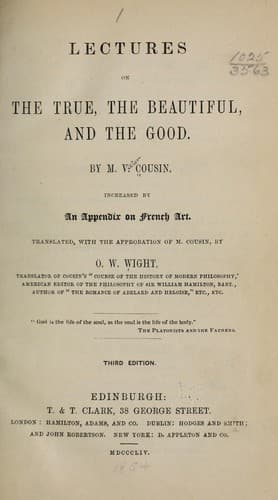
Lectures on the true, the beautiful and the goodCousin, Victor
Philosophy
Lectures on the true, the beautiful and the good
Cousin, Victor
Aesthetics; Ethics; Truth
It is true, such is the aspect under which skepticism makes us consider
society and human justice, driving us through despair to revolt and
disorder, and bringing us back through despair again to quite another
yoke than that of reason and virtue, to that regulated disorder which is
called despotism. The spectacle of human things, viewed coolly, and
without the spirit of system, is, thank God, less sombre. Without doubt,
society and human justice have still many imperfections which time
discovers and corrects; but it may be said, that in general they rest on
truth and natural equity. The proof of it is, that society everywhere
subsists, and is even developed. Moreover, facts, were they such as the
melancholy pen of a Pascal or a Rousseau represent them to be, facts are
not all,--before facts is right; and this idea of right alone, if it is
real, suffices to overturn an abasing system, and save human dignity.
Now, is the idea of right a chimera? I again appeal to languages, to
individual consciousness, to the human race,--is it not true that fact
is everywhere distinguished from right, fact which too often, perhaps,
but not always, as it is said, is opposed to right; and right that
subdues and rules fact, or protests against it? What word is it that
restrains most in human societies? Is it not that of right? Look for a
language that does not contain it. On all sides, society is bristling
with rights. There is even a distinction made between natural right and
positive right, between what is legal and what is equitable. It is
proclaimed that force should be in the service of right, and not right
at the mercy of force. The triumphs of force, wherever we perceive them,
either under our eyes, or by the aid of history in bygone centuries, or
by favor of universal publicity beyond the ocean, and in foreign
continents, rouse indignation in the disinterested spectator or reader.
On the contrary, he who inscribes on his banner the name of right, by
that alone interests us; the cause of right, or what we suppose to be
the cause of right, is for us the cause of humanity. It is also a fact,
and an incontestable fact, that in the eyes of man fact is not every
thing, and that the idea of right is a universal idea, graven in shining
and ineffaceable characters, if not in the visible world, at least in
that of thought and the soul; concerning that is the question; it is
also that which in the long run reforms and governs the other.
Individual consciousness, conceived and transferred to the entire
species, is called common sense. It is common sense that has made, that
sustains, that develops languages, natural and permanent beliefs,
society and its fundamental institutions. Grammarians have not invented
languages, nor legislators societies, nor philosophers general beliefs.
All these things have not been personally done, but by the whole
world,--by the genius of humanity.
Public-domain text, read in full here on John Shaqi.
Reviews
Reviews
No reviews yet
Be the first to share your thoughts on this work.
Elsewhere in the archive
Join the Discussion
Join the discussion
Sign in to leave a comment or review.
Sign InorCreate an account