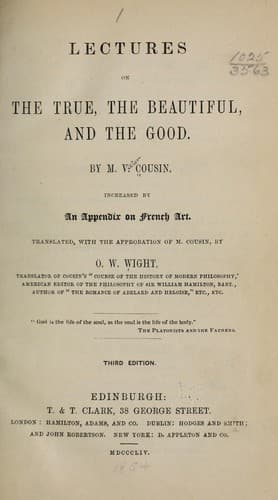
Lectures on the true, the beautiful and the goodCousin, Victor
Philosophy
Lectures on the true, the beautiful and the good
Cousin, Victor
Aesthetics; Ethics; Truth
Common sense is deposited in its works. All languages, and all human
institutions contain the ideas and the sentiments that we have just
called to mind and described, and especially the distinction between
good and evil, between justice and injustice, between free will and
desire, between duty and interest, between virtue and happiness, with
the profoundly rooted belief that happiness is a recompense due to
virtue, and that crime in itself deserves to be punished, and calls for
the reparation of a just suffering.
These things are attested by the words and actions of men. Such are the
sincere and impartial, but somewhat confused, somewhat gross notions of
common sense.
Here begins the part of philosophy. It has before it two different
routes; it can do one of two things: either accept the notions of common
sense, elucidate them, thereby develop and increase them, and, by
faithfully expressing them, fortify the natural beliefs of humanity; or,
preoccupied with such or such a principle, impose it upon the natural
data of common sense, admit those that agree with this principle,
artificially bend the others to these, or openly deny them; this is what
is called making a system.
Philosophic systems are not philosophy; they try to realize the idea of
it, as civil institutions try to realize that of justice, as the arts
express in their way infinite beauty, as the sciences pursue universal
science. Philosophic systems are necessarily very imperfect, otherwise
there never would have been two systems in the world. Fortunate are
those that go on doing good, that expand in the minds and souls of men,
with some innocent errors, the sacred love of the true, the beautiful,
and the good! But philosophic systems follow their times much more than
they direct them; they receive their spirit from the hands of their age.
Transferred to France towards the close of the regency and under the
reign of Louis XV., the philosophy of Locke gave birth there to a
celebrated school, which for a long time governed and still subsists
among us, protected by ancient habits, but in radical opposition to our
new institutions and our new wants. Sprung from the bosom of tempests,
nourished in the cradle of a revolution, brought up under the bad
discipline of the genius of war, the nineteenth century cannot recognize
its image and find its instincts in a philosophy born under the
influence of the voluptuous refinements of Versailles, admirably fitted
for the decrepitude of an arbitrary monarchy, but not for the laborious
life of a young liberty surrounded with perils. As for us, after having
combated the philosophy of sensation in the metaphysics which it
substituted for Cartesianism, and in the deplorable aesthetics, now too
accredited, under which succumbed our great national art of the
seventeenth century, we do not hesitate to combat it again in the ethics
that were its necessary product, the ethics of interest.
Public-domain text, read in full here on John Shaqi.
Reviews
Reviews
No reviews yet
Be the first to share your thoughts on this work.
Elsewhere in the archive
Join the Discussion
Join the discussion
Sign in to leave a comment or review.
Sign InorCreate an account