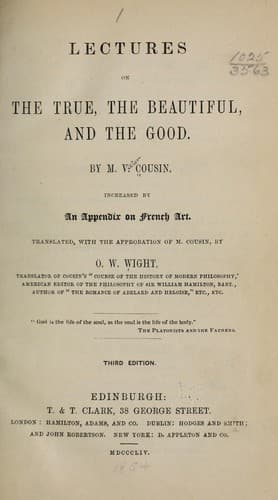
Lectures on the true, the beautiful and the goodCousin, Victor
Philosophy
Lectures on the true, the beautiful and the good
Cousin, Victor
Aesthetics; Ethics; Truth
The exposition and refutation of these pretended ethics will be the
subject of the next lecture.
FOOTNOTES:
[187] See 2d Series, vol. ii., lect. 11 and 12; 4th Series, vol. ii.,
last pages of _Jacqueline Pascal_, and the _Fragments of the Cartesian
Philosophy_, p. 469.
[188] 1st Series, vol. iii., lectures 2 and 3, _Condillac_.
[189] See the Theory of Sentiment, part i., lecture 5.
LECTURE XII.
THE ETHICS OF INTEREST.[190]
Exposition of the doctrine of interest.--What there is of truth
in this doctrine.--Its defects. 1st. It confounds liberty and
desire, and thereby abolishes liberty. 2d. It cannot explain the
fundamental distinction between good and evil. 3d. It cannot
explain obligation and duty. 4th. Nor right. 5th. Nor the
principle of merit and demerit.--Consequences of the ethics of
interest: that they cannot admit a providence, and lead to
despotism.
The philosophy of sensation, setting out from a single fact, agreeable
or painful sensation, necessarily arrives in ethics at a single
principle,--interest. The whole of the system may be explained as
follows:
Man is sensible to pleasure and pain: he shuns the one and seeks the
other. That is his first instinct, and this instinct will never abandon
him. Pleasure may change so far as its object is concerned, and be
diversified in a thousand ways: but whatever form it takes,--physical
pleasure, intellectual pleasure, moral pleasure, it is always pleasure
that man pursues.
The agreeable generalized is the useful; and the greatest possible sum
of pleasure, whatever it may be, no longer concentrated within such or
such an instant, but distributed over a certain extent of duration, is
happiness.[191]
Happiness, like pleasure, is relative to him who experiences it; it is
essentially personal. Ourselves, and ourselves alone we love, in loving
pleasure and happiness.
Interest is that which prompts us to seek in every thing our pleasure
and our happiness.
If happiness is the sole end of life, interest is the sole motive of all
our actions.
Man is only sensible to his interest, but he understands it well or ill.
Much art is necessary in order to be happy. We are not ready to give
ourselves up to all the pleasures that are offered on the highway of
life, without examining whether these pleasures do not conceal many a
pain. Present pleasure is not every thing,--it is necessary to take
thought for the future; it is necessary to know how to renounce joys
that may bring regret, and sacrifice pleasure to happiness, that is to
say, to pleasure still, but pleasure more enduring and less
intoxicating. The pleasures of the body are not the only ones,--there
are other pleasures, those of mind, even those of opinion: the sage
tempers them by each other.
Public-domain text, read in full here on John Shaqi.
Reviews
Reviews
No reviews yet
Be the first to share your thoughts on this work.
Elsewhere in the archive
Join the Discussion
Join the discussion
Sign in to leave a comment or review.
Sign InorCreate an account