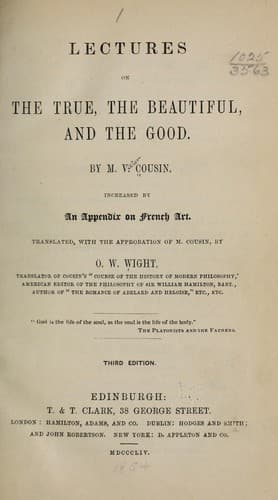
Lectures on the true, the beautiful and the goodCousin, Victor
Philosophy
Lectures on the true, the beautiful and the good
Cousin, Victor
Aesthetics; Ethics; Truth
Eclecticism is in our eyes the true historical method, and it has for us
all the importance of the history of philosophy; but there is something
which we place above the history of philosophy, and, consequently, above
eclecticism,--philosophy itself.
The history of philosophy does not carry its own light with it, it is
not its own end. How could eclecticism, which has no other field than
history, be our only, our primary, object?
It is, doubtless, just, it is of the highest utility, to discriminate in
each system what there is true in it from what there is false in it;
first, in order to appreciate this system rightly; then, in order to
render the false of no account, to disengage and re-collect the true,
and thus to enrich and aggrandize philosophy by history. But you
conceive that we must already know what truth is, in order to recognize
it, and to distinguish it from the error with which it is mixed; so that
the criticism of systems almost demands a system, so that the history of
philosophy is constrained to first borrow from philosophy the light
which it must one day return to it with usury.
In fine, the history of philosophy is only a branch, or rather an
instrument, of philosophical science. Surely it is the interest which we
feel for philosophy that alone attaches us to its history; it is the
love of truth which makes us everywhere pursue its vestiges, and
interrogate with a passionate curiosity those who before us have also
loved and sought truth.
Thus philosophy is at once the supreme object and the torch of the
history of philosophy. By this double title it has a right to preside
over our instruction.
In regard to this, one word of explanation, I beg you.
He who is speaking before you to-day is, it is true, officially charged
only with the course of the history of philosophy; in that is our task,
and in that, once more, our guide shall be eclecticism.[16] But, we
confess, if philosophy has not the right to present itself here in some
sort on the first plan; if it should appear only behind its history, it
in reality holds dominion; and to it all our wishes, as well as all our
efforts, are related. We hold, doubtless, in great esteem, both Brucker
and Tennemann,[17] so wise, so judicious; nevertheless our models, our
veritable masters, always present to our thought, are, in antiquity,
Plato and Socrates, among the moderns, Descartes, and, why should I
hesitate to say it, among us, and in our times, the illustrious man who
has been pleased to call us to this chair. M. Royer-Collard was also
only a professor of the history of philosophy; but he rightly pretended
to have an opinion in philosophy; he served a cause which he has
transmitted to us, and we will serve it in our turn.
Public-domain text, read in full here on John Shaqi.
Reviews
Reviews
No reviews yet
Be the first to share your thoughts on this work.
Join the Discussion
Join the discussion
Sign in to leave a comment or review.
Sign InorCreate an account