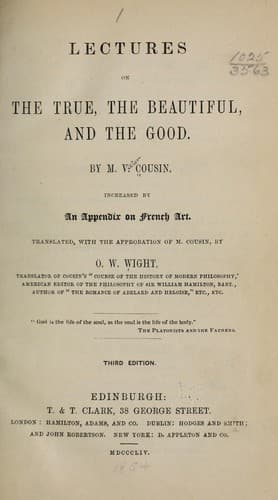
Lectures on the true, the beautiful and the goodCousin, Victor
Philosophy
Lectures on the true, the beautiful and the good
Cousin, Victor
Aesthetics; Ethics; Truth
When we examine them all with attention, we can easily reduce them to
two,--one of which, in the analysis of thought, the common subject of
all their works, gives to sensation an excessive part; the other of
which, in this same analysis, going to the opposite extreme, deduces
consciousness almost wholly from a faculty different from that of
sensation--reason. The first of these schools is the empirical school,
of which the father, or rather the wisest representative, is Locke, and
Condillac the extreme representative; the second is the spiritualistic
or rationalistic school, as it is called, which reckons among its
illustrious interpreters Reid, who is the most irreproachable, and Kant,
who is the most systematic. Surely there is truth in these two schools,
and truth is a good which must be taken wherever one finds it. We
willingly admit, with the empirical school, that the senses have not
been given us in vain; that this admirable organization which elevates
us above all other animate beings, is a rich and varied instrument,
which it would be folly to neglect. We are convinced that the spectacle
of the world is a permanent source of sound and sublime instruction.
Upon this point neither Aristotle, nor Bacon, nor Locke, has in us an
adversary, but a disciple. We acknowledge, or rather we proclaim, that
in the analysis of human knowledge, it is necessary to assign to the
senses an important part. But when the empirical school pretends that
all that passes beyond the reach of the senses is a chimera, then we
abandon it, and go over to the opposite school. We profess to believe,
for example, that, without an agreeable impression, never should we have
conceived the beautiful, and that, notwithstanding, the beautiful is not
merely the agreeable; that, thank heaven, happiness is usually added to
virtue, but that the idea itself of virtue is essentially different from
that of happiness. On this point we are openly of the opinion of Reid
and Kant. We have also established, and will again establish, that the
reason of man is in possession of principles which sensation precedes
but does not explain, and which are directly suggested to us by the
power of reason alone. We will follow Kant thus far, but not farther.
Far from following him, we will combat him, when, after having
victoriously defended the great principles of every kind against
empiricism, he strikes them with sterility, in pretending that they have
no value beyond the inclosure of the reason which possesses them,
condemning also to impotence that same reason which he has just elevated
so high, and opening the way to a refined and learned skepticism which,
after all, ends at the same abyss with ordinary skepticism.
You perceive that we shall be by turns with Locke, with Reid, and with
Kant, in that just and strong measure which is called eclecticism.
Public-domain text, read in full here on John Shaqi.
Reviews
Reviews
No reviews yet
Be the first to share your thoughts on this work.
Join the Discussion
Join the discussion
Sign in to leave a comment or review.
Sign InorCreate an account