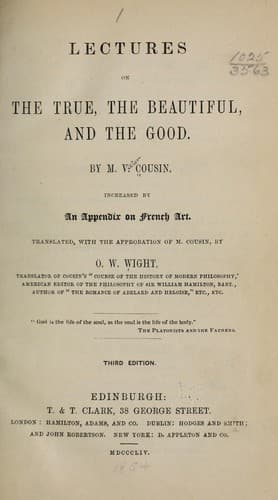
Lectures on the true, the beautiful and the goodCousin, Victor
Philosophy
Lectures on the true, the beautiful and the good
Cousin, Victor
Aesthetics; Ethics; Truth
Singular destiny of that power, so often misconceived, and yet so
manifest! Strange confounding of will and desire, wherein the most
opposite schools meet each other, Spinoza, Malebranche, and Condillac,
the philosophy of the seventeenth century, and that of the eighteenth!
One, a despiser of humanity, by an extreme and ill-understood piety,
strips man of his own activity, in order to concentrate it in God; the
other transfers it to nature. In both man is a mere instrument, nothing
else than a mode of God or a product of nature. When desire is once
taken as the type of human activity, there is an end of all liberty and
personality. A philosophy, less systematic, by conforming itself to
facts, carries through common sense to better results. By distinguishing
between the passive phenomenon of desire and the power of freely
determining self, it restores the true activity that characterizes human
personality. The will is the infallible sign and the peculiar power of a
real and effective being; for how could he who should be only a mode of
another being find in his own borrowed being a power capable of willing
and producing acts of which he should feel himself the cause, and the
responsible cause?
If the philosophy of sensation, by setting out from passive phenomena,
cannot explain true activity, voluntary and free activity, we might
regard it as demonstrated that this same philosophy cannot give a true
doctrine of morality, for all ethics suppose liberty. In order to impose
rules of action on a being, it is necessary that this being should be
capable of fulfilling or violating them. What makes the good and evil of
an action is not the action itself, but the intention that has
determined it. Before every equitable tribunal, the crime is in the
intention, and to the intention the punishment is attached. Where, then,
liberty is wanting, where there is nothing but desire and passion, not
even a shade of morality subsists. But we do not wish to reject, by the
previous question, the ethics of sensation. We proceed to examine in
itself the principle that they lay down, and to show that from this
principle can be deduced neither the idea of good and evil, nor any of
the moral ideas that are attached to it.
2d. According to the philosophy of sensation, the good is nothing else
than the useful. By substituting the useful for the agreeable, without
changing the principle, there has been contrived a convenient refuge
against many difficulties; for it will always be possible to distinguish
interest well understood from apparent and vulgar interest. But even
under this somewhat refined form, the doctrine that we are examining
none the less destroys the distinction between good and evil.
If utility is the sole measure of the goodness of actions, I must
consider only one thing when an action is proposed to me to do,--what
advantages can result from it to me?
Public-domain text, read in full here on John Shaqi.
Reviews
Reviews
No reviews yet
Be the first to share your thoughts on this work.
Elsewhere in the archive
Join the Discussion
Join the discussion
Sign in to leave a comment or review.
Sign InorCreate an account