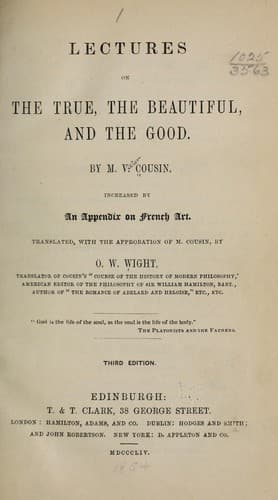
Lectures on the true, the beautiful and the goodCousin, Victor
Philosophy
Lectures on the true, the beautiful and the good
Cousin, Victor
Aesthetics; Ethics; Truth
So I make the supposition that a friend, whose innocence is known to me,
falls into disfavor with a king, or opinion--a mistress more jealous and
imperious than all kings,--and that there is danger in remaining
faithful to him and advantage in separating myself from him; if, on one
side, the danger is certain, and on the other the advantage is
infallible, it is clear that I must either abandon my unfortunate
friend, or renounce the principle of interest--of interest well
understood.
But it will be said to me:--think on the uncertainty of human things;
remember that misfortune may also overtake you, and do not abandon your
friend, through fear that you may one day be abandoned.
I respond that, at first, it is the future that is uncertain, but the
present is certain; if I can reap great and unmistakable advantages from
an action, it would be absurd to sacrifice them to the chance of a
possible misfortune. Besides, according to my supposition, all the
chances of the future are in my favor,--this is the hypothesis that we
have made.
Do not speak to me of public opinion. If personal interest is the only
rational principle, the public reason must be with me. If it were
against me, it would be an objection against the truth of the principle.
For how could a true principle, rationally applied, be revolting to the
public conscience?
Neither oppose to me remorse. What remorse can I feel for having
followed the truth, if the principle of interest is in fact moral truth?
On the contrary, I should feel satisfaction on account of it.
The rewards and punishments of another life remain. But how are we to
believe in another life, in a system that confines human consciousness
within the limits of transformed sensation?
I have, then, no motive to preserve fidelity to a friend. And mankind
nevertheless imposes on me this fidelity; and, if I am wanting in it, I
am dishonored.
If happiness is the highest aim, good and evil are not in the act
itself, but in its happy or unhappy results.
Fontenelle seeing a man led to punishment, said, "There is a man who has
calculated badly." Whence it follows that, if this man, in doing what he
did, could have escaped punishment, he would have calculated well, and
his conduct would have been laudable. The action then becomes good or
ill according to the issue. Every act is of itself indifferent, and it
is lot that qualifies it.
If the honest is only the useful, the genius of calculation is the
highest wisdom; it is even virtue!
Public-domain text, read in full here on John Shaqi.
Reviews
Reviews
No reviews yet
Be the first to share your thoughts on this work.
Elsewhere in the archive
Join the Discussion
Join the discussion
Sign in to leave a comment or review.
Sign InorCreate an account