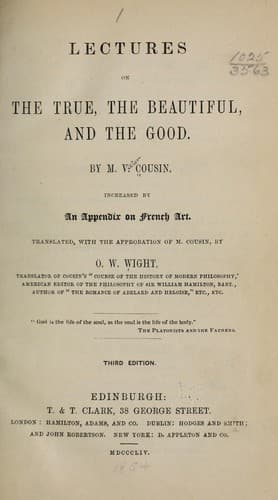
Lectures on the true, the beautiful and the goodCousin, Victor
Philosophy
Lectures on the true, the beautiful and the good
Cousin, Victor
Aesthetics; Ethics; Truth
But this genius is not within the reach of everybody. It supposes, with
long experience of life, a sure insight, capable of discerning all the
consequences of actions, a head strong and large enough to embrace and
weigh their different chances. The young man, the ignorant, the poor in
mind, are not able to distinguish between the good and the evil, the
honest and the dishonest. And even in supposing the most consummate
prudence, what place remains, in the profound obscurity of human things,
for chance and the unforeseen! In truth, in the system of interest well
understood, there must be great knowledge in order to be an honest man.
Much less is requisite for ordinary virtue, whose motto has always been:
Do what you ought, let come what may.[194] But this principle is
precisely the opposite of the principle of interest. It is necessary to
choose between them. If interest is the only principle avowed by reason,
disinterestedness is a lie and madness, and literally an
incomprehensible monster in well-ordered human nature.
Nevertheless humanity speaks of disinterestedness, and thereby it does
not simply mean that wise selfishness that deprives itself of a pleasure
for a surer, more delicate, or more durable pleasure. No one has ever
believed that it was the nature or the degree of the pleasure sought
that constituted disinterestedness. This name is awarded only to the
sacrifice of an interest, whatever it may be, to a motive free from all
interest. And the human race, not only thus understands
disinterestedness, but it believes that such a disinterestedness exists;
it believes the human soul capable of it. It admires the devotedness of
Regulus, because it does not see what interest could have impelled that
great man to go far from his country to seek, among cruel enemies, a
frightful death, when he might have lived tranquil and even honored in
the midst of his family and his fellow-citizens.
But glory, it will be said, the passion of glory inspired Regulus; it
is, then, interest still that explains the apparent heroism of the old
Roman. Admit, then, that this manner of understanding his interest is
even ridiculously absurd, and that heroes are very unskilful and
inconsistent egoists. Instead of erecting statues, with the deceived
human race, to Regulus, d'Assas, and St. Vincent de Paul, true
philosophy must send them to the Petites-Maisons, that a good regime may
cure them of generosity, charity, and greatness of soul, and restore
them to the sane state, the normal state, the state in which man only
thinks of himself, and knows no other law, no other principle of action
than his interest.
3d. If there is no liberty, if there is no essential distinction between
good and evil, if there is only interest well or ill understood, there
can be no obligation.
Public-domain text, read in full here on John Shaqi.
Reviews
Reviews
No reviews yet
Be the first to share your thoughts on this work.
Elsewhere in the archive
Join the Discussion
Join the discussion
Sign in to leave a comment or review.
Sign InorCreate an account