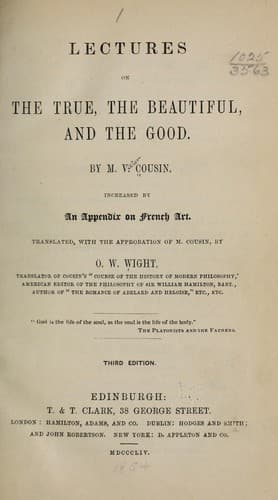
Lectures on the true, the beautiful and the goodCousin, Victor
Philosophy
Lectures on the true, the beautiful and the good
Cousin, Victor
Aesthetics; Ethics; Truth
This _resume_ was wholly made. We had only to take again the lectures
already quite old, but little known, because they belonged to a time
when the courses of the Faculte des Lettres had scarcely any influence
beyond the Quartier Latin, and, also, because they could be found only
in a considerable collection, comprising all our first instruction, from
1815 to 1821.[1] These lectures were there, as it were, lost in the
crowd. We have drawn them hence, and give them apart, severely
corrected, in the hope that they will thus be accessible to a greater
number of readers, and that their true character will the better appear.
The eighteen lectures that compose this volume have in fact the
particular trait that, if the history of philosophy furnishes their
frame-work, philosophy itself occupies in them the first place, and
that, instead of researches of erudition and criticism, they present a
regular exposition of the doctrine which was at first fixed in our mind,
which has not ceased to preside over our labors.
This book, then, contains the abridged but exact expression of our
convictions on the fundamental points of philosophic science. In it will
be openly seen the method that is the soul of our enterprise, our
principles, our processes, our results.
Under these three heads, the True, the Beautiful, the Good, we embrace
psychology, placed by us at the head of all philosophy, aesthetics,
ethics, natural right, even public right to a certain extent, finally
theodicea, that perilous _rendez-vous_ of all systems, where different
principles are condemned or justified by their consequences.
It is the affair of our book to plead its own cause. We only desire that
it may be appreciated and judged according to what it really is, and not
according to an opinion too much accredited.
Eclecticism is persistently represented as the doctrine to which men
deign to attach our name. We declare that eclecticism is very dear to
us, for it is in our eyes the light of the history of philosophy; but
the source of that light is elsewhere. Eclecticism is one of the most
important and most useful applications of the philosophy which we teach,
but it is not its principle.
Public-domain text, read in full here on John Shaqi.
Reviews
Reviews
No reviews yet
Be the first to share your thoughts on this work.
Join the Discussion
Join the discussion
Sign in to leave a comment or review.
Sign InorCreate an account