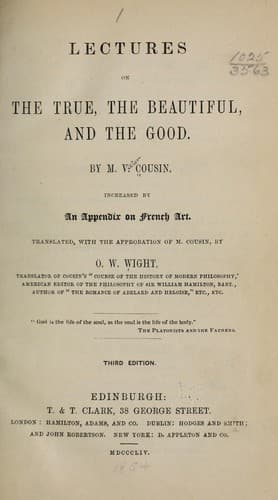
Lectures on the true, the beautiful and the goodCousin, Victor
Philosophy
Lectures on the true, the beautiful and the good
Cousin, Victor
Aesthetics; Ethics; Truth
[6] On this return to the scholastic form in Descartes, see 1st Series,
vol iv., lecture 12, especially three articles of the _Journal des
Savants_, August, September, and October, 1850, in which we have
examined anew the principles of Cartesianism, _a propos_ the _Leibnitii
Animadversiones ad Cartesii Principia Philosophiae_.
[7] See on Malebranche, Spinoza, and Leibnitz, 2d Series, vol. ii.,
lectures 11 and 12; 3d Series, vol. iv., _Introduction aux Oeuvres
Philosophiques de M. de Biran_, p. 288; and the _Fragments de
Philosophie Cartesienne_, passim.
[8] On Locke, see 1st Series, vol. iii., lecture 1, especially 2d
Series, vol. iii., _Examen du Systeme de Locke_.
[9] 1st Series, vol. iii., lectures 2 and 3.
[10] 1st Series, vol. iv., lectures on the Scotch School.
[11] See on Kant and the _Critique of Pure Reason_, vol. v. of the 1st
Series, where that great work is examined with as much extent as that of
Reid in vol. iv., and the _Essay_ of Locke in vol. iii. of the 2d
Series.
[12] On Fichte, 2d Series, vol. i., lecture 12; 3d Series, vol. iv.,
_Introduction aux Oeuvres de M. de Biran_, p. 324.
[13] We expressed ourselves thus in December, 1817, when, following the
great wars of the Revolution, and after the downfall of the empire, the
constitutional monarchy, still poorly established, left the future of
France and of the world obscure. It is sad to be obliged to hold the
same language in 1835, over the ruins accumulated around us.
[14] 1st Series, vol. i., Course of 1816.
[15] _Ibid._, Course of 1817.
[16] On the legitimate employment and the imperative conditions of
eclecticism, see 3d Series, _Fragments Philosophiques_, vol. iv.,
preface of the first edition, p. 41, &c., especially the article
entitled _De la Philosophie en Belgique_, pp. 228 and 229.
[17] We have translated his excellent _Manual of the History of
Philosophy_. See the second edition, vol. ii., 8vo., 1839.
PART FIRST.
THE TRUE.
LECTURE I.
THE EXISTENCE OF UNIVERSAL AND NECESSARY PRINCIPLES.
Two great wants, that of absolute truths, and that of absolute
truths that may not be chimeras. To satisfy these two wants is
the problem of the philosophy of our time.--Universal and
necessary principles.--Examples of different kinds of such
principles.--Distinction between universal and necessary
principles and general principles.--Experience alone is
incapable of explaining universal and necessary principles, and
also incapable of dispensing with them in order to arrive at the
knowledge of the sensible world.--Reason as being that faculty
of ours which discovers to us these principles.--The study of
universal and necessary principles introduces us to the highest
parts of philosophy.
Public-domain text, read in full here on John Shaqi.
Reviews
Reviews
No reviews yet
Be the first to share your thoughts on this work.
Join the Discussion
Join the discussion
Sign in to leave a comment or review.
Sign InorCreate an account