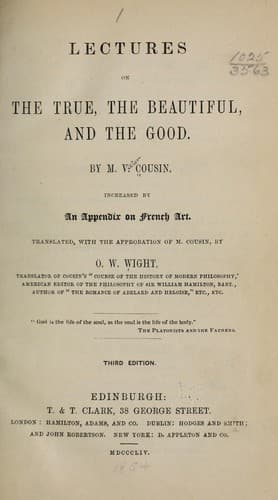
Lectures on the true, the beautiful and the good — John Shaqi
Lectures on the true, the beautiful and the goodCousin, Victor
Philosophy
Lectures on the true, the beautiful and the good
Cousin, Victor
Aesthetics; Ethics; Truth
To-day, as in all time, two great wants are felt by man. The first, the
most imperious, is that of fixed, immutable principles, which depend
upon neither times nor places nor circumstances, and on which the mind
reposes with an unbounded confidence. In all investigations, as long as
we have seized only isolated, disconnected facts, as long as we have not
referred them to a general law, we possess the materials of science, but
there is yet no science. Even physics commence only when universal
truths appear, to which all the facts of the same order that observation
discovers to us in nature may be referred. Plato has said, that there is
no science of the transitory.
This is our first need. But there is another, not less legitimate, the
need of not being the dupe of chimerical principles, of barren
abstractions, of combinations more or less ingenious, but artificial,
the need of resting upon reality and life, the need of experience. The
physical and natural sciences, whose regular and rapid conquests strike
and dazzle the most ignorant, owe their progress to the experimental
method. Hence the immense popularity of this method, which is carried to
such an extent that one would not now condescend to lend the least
attention to a science over which this method should not seem to
preside.
To unite observation and reason, not to lose sight of the ideal of
science to which man aspires, and to search for it and find it by the
route of experience,--such is the problem of philosophy.
Now we address ourselves to your recollections of the last two
years:--have we not established, by the severest experimental method, by
reflection applied to the study of the human mind, with the deliberation
and the rigor which such demonstrations exact,--have we not established
that there are in all men, without distinction, in the wise and the
ignorant, ideas, notions, beliefs, principles which the most determined
skeptic cannot in the slightest degree deny, by which he is
unconsciously, and in spite of himself, governed both in his words and
actions, and which, by a striking contrast with our other knowledges,
are marked with the at once marvellous and incontestable character, that
they are encountered in the most common experience, and that, at the
same time, instead of being circumscribed within the limits of this
experience, they surpass and govern it, universal in the midst of
particular phenomena to which they are applied; necessary, although
mingled with things contingent; to our eyes infinite and absolute, even
while appearing within us in that relative and finite being which we
are? It is not an unpremeditated paradox that we present to you; we are
only expressing here the result of numerous lectures.[18]
It was not difficult for us to show that there are universal and
necessary principles at the head of all sciences.
It is very evident that there are no mathematics without axioms and
definitions, that is to say, without absolute principles.
Public-domain text, read in full here on John Shaqi.
Reviews
Reviews
No reviews yet
Be the first to share your thoughts on this work.
Join the Discussion
Join the discussion
Sign in to leave a comment or review.
Sign InorCreate an account