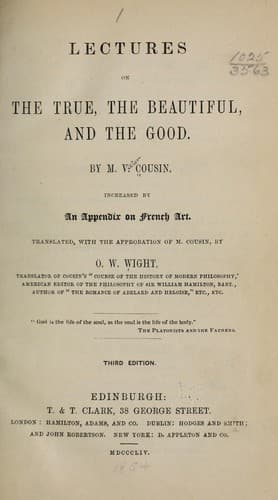
Lectures on the true, the beautiful and the goodCousin, Victor
Philosophy
Lectures on the true, the beautiful and the good
Cousin, Victor
Aesthetics; Ethics; Truth
Another _petitio principii_ still more evident. In the first place, you
are compelled, in order legitimately to draw justice from the will of
God, to suppose that this will is just, or I defy any one to show that
this will alone can ever form the basis of justice. Moreover, evidently
you cannot comprehend what a just will of God is, if you do not already
possess the idea of justice. This idea, then, does not come from that of
the will of God.
On the one hand, you may have, and you do have, the idea of justice,
without understanding the will of God; on the other, you cannot conceive
the justice of the divine will, without having conceived justice
elsewhere.
Are not these reasons sufficient, I pray you, to conclude that the sole
will of God is not for us the principle of the idea of the good?
And now, behold the natural consummation of the ethical system that we
are examining:--the just and the unjust are what it has pleased God to
declare such, by attaching to them the rewards and punishments of
another life. The divine will manifests itself here only by an arbitrary
order; it adds to this order promises and threats.
But to what human faculty are addressed the promise and threat of the
chastisements and the rewards of another life? To the same one that in
this life fears pain and seeks pleasure, shuns unhappiness and desires
happiness, that is to say, to sensibility animated by imagination, that
is to say, again, to what is most changing in each of us and most
different in the human species. The joys and sufferings of another life
excite in us the two most vivid but most mobile passions, hope and fear.
Every thing influences our fears and hopes,--aye, health, the passing
cloud, a ray of the sun, a cup of coffee, a thousand causes of this
kind. I have known men, even philosophers, who on certain days hoped
more, and other days less. And such a basis some would give to ethics!
Then it is doing nothing else than proposing for human conduct an
interested motive. The calculation which I obey is purer, if you will;
the happiness that one makes me hope for is greater; but I see in that
no justice that obligates me, no virtue and no vice in me, who know or
do not know how to make this calculation, not having a head as strong as
that of Pascal,[214] who yield to or resist those fears and hopes
according to the deposition of my sensibility and my imagination, over
which I have no power. Finally, the pains and pleasures of the future
life are instituted on the ground of punishments and rewards. Now, none
but actions in themselves good or bad can be rewarded and punished. If
already there is in itself no good, no law that in conscience we are
obligated to follow, there is neither merit nor demerit; recompense is
not then recompense, nor penalty penalty, since they are such only on
the condition of being the complement and the sanction of the idea of
the good. Where this idea does not pre-exist, there remain, instead of
Public-domain text, read in full here on John Shaqi.
Reviews
Reviews
No reviews yet
Be the first to share your thoughts on this work.
Elsewhere in the archive
Join the Discussion
Join the discussion
Sign in to leave a comment or review.
Sign InorCreate an account