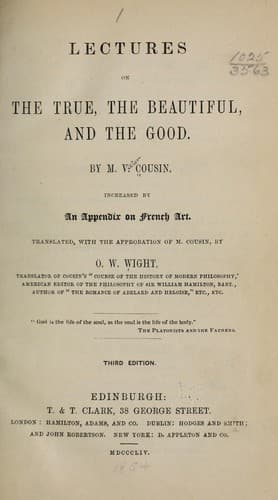
Lectures on the true, the beautiful and the goodCousin, Victor
Philosophy
Lectures on the true, the beautiful and the good
Cousin, Victor
Aesthetics; Ethics; Truth
recompense and penalty, only the attraction of pleasure and the fear of
suffering, added to a prescription deprived in itself of morality. In
that we come back to the punishments of earth invented for the purpose
of frightening popular imagination, and supported solely on the decrees
of legislators, on an abstraction of good and evil, of justice and
injustice, of merit and demerit. It is the worst human justice that is
found thus transported into heaven. We shall see that the human soul has
foundation somewhat solider.[215]
These different systems, false or incomplete, having been rejected, we
arrive at the doctrine that is to our eyes perfect truth, because it
admits only certain facts, neglects none, and maintains for all of them
their character and rank.
FOOTNOTES:
[203] _Mordre_--to bite, is the main root of _remords_--remorse.
[204] See 1st part, lecture 5, _On Mysticism_, and 2d part, lecture 6,
_On the Sentiment of the Beautiful_. See, also, 1st Series, vol. iv.,
detailed refutation of the Theories of Hutcheson and Smith.
[205] We do not grow weary of citing M. Royer-Collard. He has marked the
defects of the ethics of sentiment in a lively and powerful passage,
from which we borrow some traits. _Oeuvres de Reid_, vol. iii., p.
410, 411: "The perception of the moral qualities of human actions is
accompanied by an emotion of the soul that is called _sentiment_.
Sentiment is a support of nature that invites us to good by the
attraction of the noblest joys of which man is capable, and turns us
from evil by the contempt, the aversion, the horror with which it
inspires us. It is a fact that by the contemplation of a beautiful
action or a noble character, at the same time that we perceive these
qualities of the action and the character (perception, which is a
judgment), we feel for the person a love mingled with respect, and
sometimes an admiration that is full of tenderness. A bad action, a
loose and perfidious character, excite a contrary perception and
sentiment. The internal approbation of conscience and remorse are
sentiments attached to the perception of the moral qualities of our own
actions.... I do not weaken the part of sentiment; yet it is not true
that ethics are wholly in sentiment; if we maintain this, we annihilate
moral distinctions.... Let ethics be wholly in sentiment, and nothing is
in itself good, nothing is in itself evil; good and evil are relative;
the qualities of human actions are precisely such as each one feels them
to be. Change sentiment, and you change every thing; the same action is
at once good, indifferent, and bad, according to the affection of the
spectator. Silence sentiment, and actions are only physical phenomena;
obligation is resolved into inclinations, virtue into pleasure, honesty
into utility. Such are the ethics of Epicurus: _Dii meliora piis_!"
[206] In this formula is recognized the system of Bentham, who, for some
time, had numerous partisans in England, and even in France.
Public-domain text, read in full here on John Shaqi.
Reviews
Reviews
No reviews yet
Be the first to share your thoughts on this work.
Elsewhere in the archive
Join the Discussion
Join the discussion
Sign in to leave a comment or review.
Sign InorCreate an account