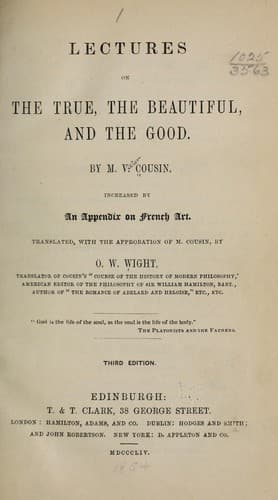
Lectures on the true, the beautiful and the goodCousin, Victor
Philosophy
Lectures on the true, the beautiful and the good
Cousin, Victor
Aesthetics; Ethics; Truth
Remorse is a suffering of a particular character. In remorse I do not
suffer on account of such an impression made upon my senses, nor on
account of the thwarting of my natural passions, nor on account of the
injury done or threatened to my interest, nor by the disquietude of my
hopes and the agony of my fears: no, I suffer without any external
cause, yet I suffer in the most cruel manner. I suffer for the sole
reason that I have a consciousness of having committed a bad action
which I knew I was obligated not to commit, which I was able not to
commit, which leaves behind it a chastisement that I know to be
deserved. No exact analysis can take away from remorse, without
destroying it, a single one of these elements. Remorse contains the idea
of good and evil, of an obligatory law, of liberty, of merit and
demerit. All these ideas were already in the struggle between good and
evil; they reappear in remorse. In vain interest counselled me to
appropriate the deposit that had been confided to me; something said to
me, and still says to me, that to appropriate it is to do evil, is to
commit an injustice; I judged, and judge, thus, not such a day, but
always, not under such a circumstance, but under all circumstances. In
vain I say to myself that the person to whom I ought to remit this
deposit has no need of it, and that it is necessary to me; I judge that
a deposit must be respected without regard to persons, and the
obligation that is imposed on me appears inviolable and absolute. Having
taken upon myself this obligation, I believe by this fact alone that I
have the power to fulfil it: this is not all; I am directly conscious of
this power, I know with the most certain knowledge that I am able to
keep this deposit or to remit it to the lawful owner; and it is
precisely because I am conscious of this power that I judge that I have
deserved punishment for not having made the use of it for which it was
given me. It is, in fine, because I have a lively consciousness of all
that, that I experience this sentiment of indignation against myself,
this suffering of remorse which expresses in itself the moral phenomenon
entire.
Public-domain text, read in full here on John Shaqi.
Reviews
Reviews
No reviews yet
Be the first to share your thoughts on this work.
Elsewhere in the archive
Join the Discussion
Join the discussion
Sign in to leave a comment or review.
Sign InorCreate an account