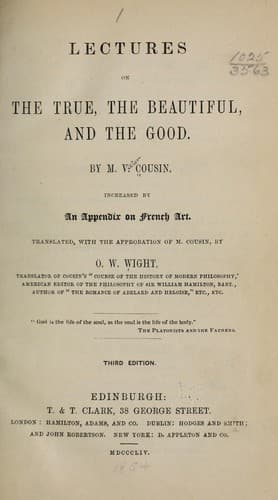
Lectures on the true, the beautiful and the goodCousin, Victor
Philosophy
Lectures on the true, the beautiful and the good
Cousin, Victor
Aesthetics; Ethics; Truth
According to the rules of the experimental method, let us take an
opposite course; let us suppose that, in spite of the suggestions of
interest, in spite of the pressing goad of misery, in order to be
faithful to pledged faith, I send the deposit to the person that had
been designated to me; instead of the painful scene that just now passed
in consciousness, there passes another quite as real, but very
different. I know that I have done well; I know that I have not obeyed a
chimera, an artificial and mendacious law, but a law true, universal,
obligatory upon all intelligent and free beings. I know that I have made
a good use of my liberty; I have of this liberty, by the very use that I
have made of it, a sentiment more distinct, more energetic, and, in some
sort, triumphant. Every opinion would accuse me in vain, I appeal from
it to a better justice, and this justice is already declared in me by
sentiments that press upon each other in my soul. I respect myself,
esteem myself, and believe that I have a right to the esteem of others;
I have the sentiment of my dignity; I feel for myself only sentiments of
affection opposed to that species of horror for myself with which I was
just now inspired. Instead of remorse, I feel an incomparable joy that
no one can deprive me of, that, were every thing else wanting to me,
would console and support me. This sentiment of pleasure is as
penetrating, as profound as was the remorse. It expresses the
satisfaction of all the generous principles of human nature, as remorse
represented their revolt. It testifies by the internal happiness that it
gives me to the sublime accord between happiness and virtue, whilst
remorse is the first link in that fatal chain, that chain of iron and
adamant, which, according to Plato,[218] binds pain to transgression,
trouble to passion, misery to faithlessness, vice, and crime.
Moral sentiment is the echo of all the moral judgments and entire moral
life. It is so striking that it has been regarded by a somewhat
superficial philosophy as sufficient to found entire ethics; and,
nevertheless, we have just seen that this admirable sentiment would not
exist without the different judgments that we have just enumerated; it
is their consequence, but not their principle; it supplies, but does not
constitute them; it does not take their place, but sums them up.
Now that we are in possession of all the elements of human morality, we
proceed to take these elements one by one, and submit them to a detailed
analysis.
That which is most apparent in the complex phenomenon that we are
studying is sentiment; but its foundation is judgment.
The judgment of good and evil is the principle of all that follows it;
but this judgment rests only on the constitution itself of human nature,
like the judgment of the true and the judgment of the beautiful. As well
as these two judgments,[219] that of the good is a simple, primitive,
indecomposable judgment.
Public-domain text, read in full here on John Shaqi.
Reviews
Reviews
No reviews yet
Be the first to share your thoughts on this work.
Elsewhere in the archive
Join the Discussion
Join the discussion
Sign in to leave a comment or review.
Sign InorCreate an account