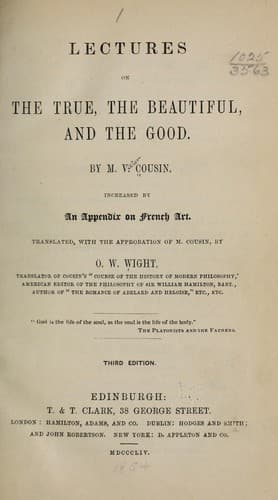
Lectures on the true, the beautiful and the goodCousin, Victor
Philosophy
Lectures on the true, the beautiful and the good
Cousin, Victor
Aesthetics; Ethics; Truth
Like them, again, it is not arbitrary. We cannot but fear this judgment
in presence of certain acts; and, in fearing it, we know that it does
not make good or evil, but declares it. The reality of moral
distinctions is revealed by this judgment, but it is independent of it,
as beauty is independent of the eye that perceives it, as universal and
necessary truths are independent of the reason that discovers them.[220]
Good and evil are real characters of human actions, although these
characters might not be seen with our eyes nor touched with our hands.
The moral qualities of an action are none the less real for not being
confounded with the material qualities of this action. This is the
reason why actions materially identical may be morally very different. A
homicide is always a homicide; nevertheless, it is often a crime, it is
also often a legitimate action, for example, when it is not done for the
sake of vengeance, nor for the sake of interest, in a strict case of
self-defence.
It is not the spilling of blood that makes the crime, it is the spilling
of innocent blood. Innocence and crime, good and evil, do not reside in
such or such an external circumstance determined one for all. Reason
recognizes them with certainty under the most different appearances, in
circumstances sometimes the same and sometimes dissimilar.
Good and evil almost always appear to us connected with particular
actions; but it is not on account of what is particular in them that
these actions are good or bad. So when I declare that the death of
Socrates is unjust, and that the devotion of Leonidas is admirable, it
is the unjust death of a wise man that I condemn, and the devotion of a
hero that I admire. It is not important whether this hero be called
Leonidas or d'Assas, whether the immolated sage be called Socrates or
Bailly.
The judgment of the good is at first applied to particular actions, and
it gives birth to general principles which in course serve us as rules
for judging all actions of the same kind. As after having judged that
such a particular phenomenon has such a particular cause, we elevate
ourselves to the general principle that every phenomenon has its
cause;[221] so we erect into a general rule the moral judgment that we
have borne in regard to a particular fact. Thus, at first we admire the
death of Leonidas, thence we elevate ourselves to the principle that it
is good to die for one's country. We already possess the principle in
its first application to Leonidas; otherwise, this particular
application would not have been legitimate, it would not have been even
possible; but we possess it implicitly; as soon as it is disengaged, it
appears to us under its universal and pure form, and we apply it to all
analogous cases.
Ethics have their axioms like other sciences; and these axioms are
rightly called in all languages moral truths.
Public-domain text, read in full here on John Shaqi.
Reviews
Reviews
No reviews yet
Be the first to share your thoughts on this work.
Elsewhere in the archive
Join the Discussion
Join the discussion
Sign in to leave a comment or review.
Sign InorCreate an account