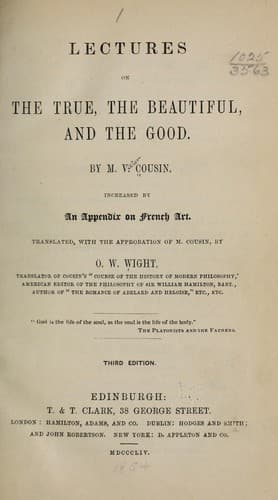
Lectures on the true, the beautiful and the goodCousin, Victor
Philosophy
Lectures on the true, the beautiful and the good
Cousin, Victor
Aesthetics; Ethics; Truth
It is good not to violate one's oath, and in this is also involved a
truth. In fact, an oath is founded in the truth of things,--its good is
only derived. Moral truths considered in themselves have no less
certainty than mathematical truths. The idea of a deposit being given, I
ask whether the idea of faithfully keeping it is not necessarily
attached to it, as to the idea of a triangle is attached the idea that
its three angles are equal to two right angles. You may withhold a
deposit; but, in withholding it, do not believe that you change the
nature of things, nor that you make it possible for a deposit ever to
become property. These two ideas exclude each other. You have only a
false semblance of property; and all the efforts of passion, all the
sophisms of interest will not reverse the essential differences. This is
the reason why moral truth is so troublesome,--it is because, like all
truth, it is what it is, and does not bend to any caprice. Always the
same and always present, in spite of all our efforts, it inexorably
condemns, with a voice always heard, but not always listened to, the
sensible and the culpable will which thinks to hinder it from being by
denying it, or rather by pretending to deny it.
Moral truths are distinguished from other truths by the singular
character that, as soon as we perceive them, they appear to us as the
rule of our conduct. If it is true that a deposit is made to be remitted
to its legitimate possessor, it is necessary to remit it to him. To the
necessity of believing is here added the necessity of practising.
The necessity of practising is obligation. Moral truths, in the eyes of
reason necessary, are to the will obligatory.
Moral obligation, like the moral truth that is its foundation, is
absolute. As necessary truths are not more or less necessary,[222] so
obligation is not more or less obligatory. There are degrees of
importance between different obligations; but there are no degrees in
the same obligation. We are not somewhat obligated, almost obligated; we
are either wholly obligated, or not at all.
If obligation is absolute, it is immutable and universal. For, if the
obligation of to-day were not the obligation of to-morrow, if what is
obligatory for me were not so for you, obligation would differ from
itself, would be relative and contingent.
This fact of absolute, immutable, universal obligation is so certain and
so manifest, in spite of all the efforts of the doctrine of interest to
obscure it, that one of the profoundest moralists of modern philosophy,
particularly struck with this fact, has regarded it as the principle of
the whole of ethics. By separating duty from interest which ruins it,
and from sentiment which enervates it, Kant restored to ethics their
true character. He elevated himself very high in the century of
Helvetius, in elevating himself to the holy law of duty; but he still
did not ascend high enough, he did not reach the reason itself of duty.
Public-domain text, read in full here on John Shaqi.
Reviews
Reviews
No reviews yet
Be the first to share your thoughts on this work.
Elsewhere in the archive
Join the Discussion
Join the discussion
Sign in to leave a comment or review.
Sign InorCreate an account