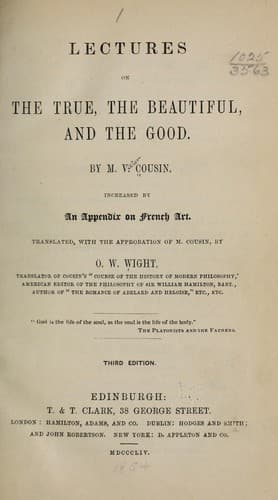
Lectures on the true, the beautiful and the goodCousin, Victor
Philosophy
Lectures on the true, the beautiful and the good
Cousin, Victor
Aesthetics; Ethics; Truth
The good for Kant is what is obligatory. But logically, whence comes the
obligation of performing an action, if not from the intrinsic goodness
of this act? Is it not because that, in the order of reason, it is
absolutely impossible to regard a deposit as a property, that we cannot
appropriate it to ourselves without a crime? If one action must be
performed, and another action must not, it is because there is
apparently an essential difference between these two acts. To found the
good on obligation, instead of founding obligation on the good, is,
therefore, to take the effect for the cause, is to draw the principle
from the consequence.
If I ask an honest man who, in spite of the suggestions of misery, has
respected the deposit that was intrusted to him, why he respected it, he
will answer me,--because it was my duty. If I persist, and ask why it
was his duty, he will very rightly answer,--because it was just, because
it was good. That point having been reached, all answers are stopped;
but questions also are stopped. No one allows a duty to be imposed upon
him without rendering to himself a reason for it; but as soon as it is
recognized that this duty is imposed upon us because it is just, the
mind is satisfied; for it reaches a principle beyond which it has
nothing more to seek, justice being its own principle. First truths
carry with them their reason for being. Now, justice, the essential
distinction between good and evil in the relations of men among
themselves, is the primary truth of ethics.
Justice is not a consequence, since we cannot ascend to another more
elevated principle; and duty is not, rigorously speaking, a principle,
since it supposes a principle above it, that explains and authorizes it,
to wit, justice.
Moral truth no more becomes relative and subjective, to take for a
moment the language of Kant, in appearing to us obligatory, than truth
becomes relative and subjective in appearing to us necessary; for in the
very nature of truth and the good must be sought the reason of necessity
and obligation. But if we stop at obligation and necessity, as Kant did,
in ethics as well as in metaphysics, without knowing it, and even
against our intention, we destroy, or at least weaken truth and the
good.[223]
Obligation has its foundation in the necessary distinction between good
and evil; and is itself the foundation of liberty. If man has duties,
he must possess the faculty of fulfilling them, of resisting desire,
passion, and interest, in order to obey law. He ought to be free,
therefore he is free, or human nature is in contradiction with itself.
The direct certainty of obligation implies the corresponding certainty
of liberty.
Public-domain text, read in full here on John Shaqi.
Reviews
Reviews
No reviews yet
Be the first to share your thoughts on this work.
Elsewhere in the archive
Join the Discussion
Join the discussion
Sign in to leave a comment or review.
Sign InorCreate an account