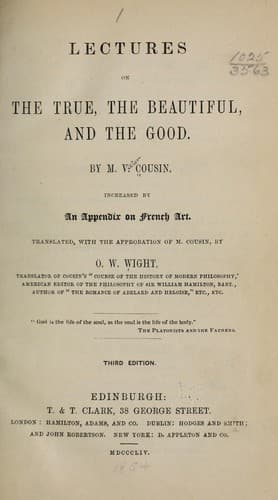
Lectures on the true, the beautiful and the goodCousin, Victor
Philosophy
Lectures on the true, the beautiful and the good
Cousin, Victor
Aesthetics; Ethics; Truth
This proof of liberty is doubtless good; but Kant is deceived in
supposing it the only legitimate proof. It is very strange that he
should have preferred the authority of reasoning to that of
consciousness, as if the former had no need of being confirmed by the
latter; as if, after all, my liberty ought not to be a fact for me.[224]
Empiricism must be greatly feared to distrust the testimony of
consciousness; and, after such a distrust, one must be very credulous to
have a boundless faith in reasoning. We do not believe in our liberty as
we believe in the movement of the earth. The profoundest persuasion that
we have of it comes from the continual experience that we carry with
ourselves.
Is it true that in presence of an act to be done I am able to will or
not to will to do it? In that lies the whole question of liberty.
Let us clearly distinguish between the power of doing and the power of
willing. The will has, without doubt, in its service and under its
empire, the most of our faculties; but that empire, which is real, is
very limited. I will to move my arm, and I am often able to do it,--in
that resides, as it were, the physical power of will; but I am not
always able to move my arm, if the muscles are paralyzed, if the
obstacle to be overcome is too strong, &c.; the execution does not
always depend on me; but what always depends on me is the resolution
itself. The external effects may be hindered, my resolution itself can
never be hindered. In its own domain, will is sovereign.
And I am conscious of this sovereign power of the will. I feel in
myself, before its determination, the force that can determine itself in
such a manner or in such another. At the same time that I will this or
that, I am equally conscious of the power to will the opposite; I am
conscious of being master of my resolution, of the ability to arrest it,
continue it, repress it. When the voluntary act ceases, the
consciousness of the power does not cease,--it remains with the power
itself, which is superior to all its manifestations. Liberty is
therefore the essential and always-subsisting attribute of will.[225]
Public-domain text, read in full here on John Shaqi.
Reviews
Reviews
No reviews yet
Be the first to share your thoughts on this work.
Elsewhere in the archive
Join the Discussion
Join the discussion
Sign in to leave a comment or review.
Sign InorCreate an account