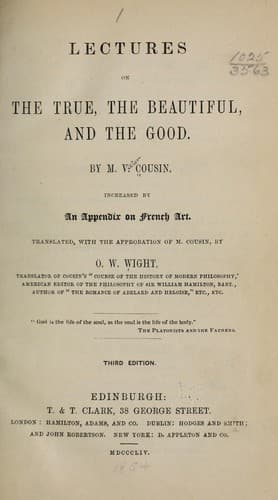
Lectures on the true, the beautiful and the goodCousin, Victor
Philosophy
Lectures on the true, the beautiful and the good
Cousin, Victor
Aesthetics; Ethics; Truth
The will, we have seen,[226] is neither desire nor passion,--it is
exactly the opposite. Liberty of will is not, then, the license of
desires and passions. Man is a slave in desire and passion, he is free
only in will. That they may not elsewhere be confounded, liberty and
anarchy must not be confounded in psychology. Passions abandoning
themselves to their caprices, is anarchy. Passions concentrated upon a
dominant passion, is tyranny. Liberty consists in the struggle of will
against this tyranny and this anarchy. But this combat must have an aim,
and this aim is the duty of obeying reason, which is our true sovereign,
and justice, which reason reveals to us and prescribes for us. The duty
of obeying reason is the law of will, and will is never more itself than
when it submits to its law. We do not possess ourselves, as long as to
the domination of desire, of passion, of interest, reason does not
oppose the counterpoise of justice. Reason and justice free us from the
yoke of passions, without imposing upon us another yoke. For, once more,
to obey them, is not to abdicate liberty, but to save it, to apply it to
its legitimate use.
It is in liberty, and in the agreement of liberty with reason and
justice, that man belongs to himself, to speak properly. He is a person
only because he is a free being enlightened by reason.
What distinguishes a person from a simple thing, is especially the
difference between liberty and its opposite. A thing is that which is
not free, consequently that which does not belong to itself, that which
has no self, which has only a numerical individuality, a perfect effigy
of true individuality, which is that of person.
A thing, not belonging to itself, belongs to the first person that takes
possession of it and puts his mark on it.
A thing is not responsible for the movements which it has not willed, of
which it is even ignorant. Person alone is responsible, for it is
intelligent and free; and it is responsible for the use of its
intelligence and freedom.
A thing has no dignity; dignity is only attached to person.
A thing has no value by itself; it has only that which person confers on
it. It is purely an instrument whose whole value consists in the use
that the person using it derives from it.[227]
Obligation implies liberty; where liberty is not, duty is wanting, and
with duty right is wanting also.
It is because there is in me a being worthy of respect, that I have the
duty of respecting it, and the right to make it respected by you. My
duty is the exact measure of my right. The one is in direct ratio with
the other. If I had no sacred duty to respect what makes my person, that
is to say, my intelligence and my liberty, I should not have the right
to defend it against your injuries. But as my person is inviolable and
sacred in itself, it follows that, considered in relation to me, it
imposes on me a duty, and, considered in relation to you, it confers on
me a right.
Public-domain text, read in full here on John Shaqi.
Reviews
Reviews
No reviews yet
Be the first to share your thoughts on this work.
Elsewhere in the archive
Join the Discussion
Join the discussion
Sign in to leave a comment or review.
Sign InorCreate an account