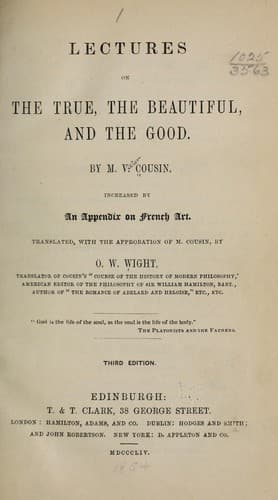
Lectures on the true, the beautiful and the goodCousin, Victor
Philosophy
Lectures on the true, the beautiful and the good
Cousin, Victor
Aesthetics; Ethics; Truth
I am not myself permitted to degrade the person that I am by abandoning
myself to passion, to vice and crime, and I am not permitted to let it
be degraded by you.
The person is inviolable; and it alone is inviolable.
It is inviolable not only in the intimate sanctuary of consciousness,
but in all its legitimate manifestations, in its acts, in the product
of its acts, even in the instruments that it makes its own by using
them.
Therein is the foundation of the sanctity of property. The first
property is the person. All other properties are derived from that.
Think of it well. It is not property in itself that has rights, it is
the proprietor, it is the person that stamps upon it, with its own
character, its right and its title.
The person cannot cease to belong to itself, without degrading
itself,--it is to itself inalienable. The person has no right over
itself; it cannot treat itself as a thing, cannot sell itself, cannot
destroy itself, cannot in any way abolish its free will and its liberty,
which are its constituent elements.
Why has the child already some rights? Because it will be a free being.
Why have the old man, returned to infancy, and the insane man still some
rights? Because they have been free beings. We even respect liberty in
its first glimmerings or its last vestiges. Why, on the other hand, have
the insane man and the imbecile old man no longer all their rights?
Because they have lost liberty. Why do we enchain the furious madman?
Because he has lost knowledge and liberty. Why is slavery an abominable
institution? Because it is an outrage upon what constitutes humanity.
This is the reason why, in fine, certain extreme devotions are sometimes
sublime faults, and no one is permitted to offer them, much less to
demand them. There is no legitimate devotion against the very essence of
right, against liberty, against justice, against the dignity of the
human person.
We have not been able to speak of liberty, without indicating a certain
number of moral notions of the highest importance which it contains and
explains; but we could not pursue this development without encroaching
upon the domain of private and public ethics and anticipating the
following lecture.
We arrive, then, at the last element of the moral phenomenon, the
judgment of merit and demerit.
Public-domain text, read in full here on John Shaqi.
Reviews
Reviews
No reviews yet
Be the first to share your thoughts on this work.
Elsewhere in the archive
Join the Discussion
Join the discussion
Sign in to leave a comment or review.
Sign InorCreate an account