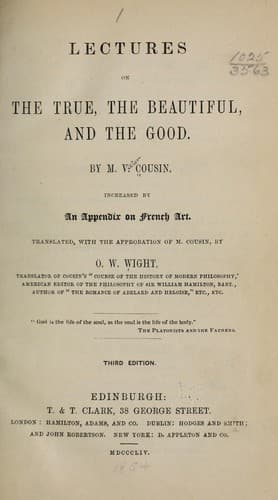
Lectures on the true, the beautiful and the goodCousin, Victor
Philosophy
Lectures on the true, the beautiful and the good
Cousin, Victor
Aesthetics; Ethics; Truth
At the same time that we judge that a man has done a good or bad action,
we bear this other judgment quite as necessary as the former, to wit,
that if this man has acted well he has merited a reward, and if he has
acted ill, he has merited a punishment. It is exactly the same with this
judgment as with that of the good. It may be outwardly expressed in a
more or less lively manner, according as it is mingled with more or less
energetic feelings. Sometimes it will be only a benevolent disposition
towards the virtuous agent, and an unfavorable disposition towards the
culpable agent; sometimes it will be enthusiasm or indignation. In some
cases one will make himself the executor of the judgment that he bears,
he will crown the hero and load the criminal with chains. But when all
your feelings are calmed, when enthusiasm has cooled as well as
indignation, when time and separation have rendered an action almost
indifferent to you, you none the less persist in judging that the author
of this action merits a reward or a punishment, according to the quality
of the action. You decide that you were right in the sentiments that you
felt, and, although they are extinguished, you declare them legitimate.
The judgment of merit and demerit is essentially tied to the judgment of
good and evil. In fact, he who does an action without knowing whether it
is good or bad, has neither merit nor demerit in doing it. It is with
him the same as with those physical agents that accomplish the most
beneficent or the most destructive works, to which we never think of
attributing knowledge and will, consequently accountability. Why are
there no penalties attached to involuntary crimes? Because for that very
reason they are not regarded as crimes. Hence it comes that the question
of premeditation is so grave in all criminal processes. Why is the
child, up to a certain age, subject to none but light punishments?
Because where the idea of the good and liberty are wanting, merit and
demerit are also wanting, which alone authorize reward and punishment.
The author of an injurious but involuntary action is condemned to an
indemnity corresponding to the damage done; he is not condemned to a
punishment properly so called.
Such are the conditions of merit and demerit. When these conditions are
fulfilled, merit and demerit manifest themselves, and involve reward and
punishment.
Public-domain text, read in full here on John Shaqi.
Reviews
Reviews
No reviews yet
Be the first to share your thoughts on this work.
Elsewhere in the archive
Join the Discussion
Join the discussion
Sign in to leave a comment or review.
Sign InorCreate an account