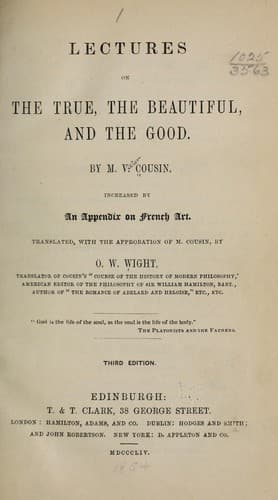
Lectures on the true, the beautiful and the goodCousin, Victor
Philosophy
Lectures on the true, the beautiful and the good
Cousin, Victor
Aesthetics; Ethics; Truth
Merit is the natural right we have to be rewarded; demerit the natural
right that others have to punish us, and, if we may thus speak, the
right that we have to be punished. This expression may seem paradoxical,
nevertheless it is true. A culpable man, who, opening his eyes to the
light of the good, should comprehend the necessity of expiation, not
only by internal repentance, without which all the rest is in vain, but
also by a real and effective suffering, such a culpable man would have
the right to claim the punishment that alone can reconcile him with
order. And such reclamations are not so rare. Do we not every day see
criminals denouncing themselves and offering themselves up to avenge the
public? Others prefer to satisfy justice, and do not have recourse to
the pardon that law places in the hands of the monarch in order to
represent in the state charity and mercy, as tribunals represent in it
justice. This is a manifest proof of the natural and profound roots of
the idea of punishment and reward.
Merit and demerit imperatively claim, like a lawful debt, punishment and
reward; but reward must not be confounded with merit, nor punishment
with demerit; this would be confounding cause and effect, principle and
consequence. Even were reward and punishment not to take place, merit
and demerit would subsist. Punishment and reward satisfy merit and
demerit, but do not constitute them. Suppress all reward and all
punishment and you do not thereby suppress merit and demerit; on the
contrary, suppress merit and demerit, and there are no longer true
punishments and true rewards. Unmerited goods and honors are only
material advantages; reward is essentially moral, and its value is
independent of its form. One of those crowns of oak that the early
Romans decreed to heroism is worth more than all the riches in the
world, when it is the sign of the recognition and the admiration of a
people. To reward is to give in return. He who is rewarded must have
first given something in order to deserve to be rewarded. Reward
accorded to merit is a debt; reward without merit is a charity or a
theft. It is the same with punishment. It is the relation of pain to a
fault,--in this relation, and not in the pain alone, is the truth as
well as the shame of chastisement.
'Tis crime and not the scaffold makes the shame.[228]
There are two things that must be unceasingly repeated, because they are
equally true,--the first is, that the good is good in itself, and ought
to be pursued whatever may be the consequences; the second is, that the
consequences of the good cannot fail to be fortunate. Happiness,
separated from the good, is only a fact to which is attached no moral
idea; but, as an effect of the good, it enters into the moral order and
completes it.
Public-domain text, read in full here on John Shaqi.
Reviews
Reviews
No reviews yet
Be the first to share your thoughts on this work.
Elsewhere in the archive
Join the Discussion
Join the discussion
Sign in to leave a comment or review.
Sign InorCreate an account