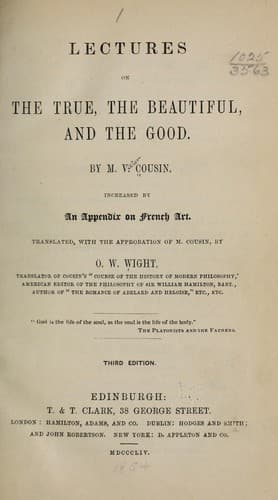
Lectures on the true, the beautiful and the goodCousin, Victor
Philosophy
Lectures on the true, the beautiful and the good
Cousin, Victor
Aesthetics; Ethics; Truth
Virtue without happiness, and crime without unhappiness, are a
contradiction, a disorder. If virtue supposes sacrifice, that is to say,
suffering, it is of eternal justice that the sacrifice, generously
accepted and courageously borne, have for a reward the very happiness
that has been sacrificed. So, it is of eternal justice that crime be
punished by the unhappiness of the culpable happiness which it has tried
to obtain by stealth.
Now, when and how is the law fulfilled that attaches pleasure and pain
to good and evil? Most of the time even here below. For order rules in
this world, since the world endures. If order is sometimes disturbed,
and happiness and unhappiness are not always distributed in right
proportion to crime and virtue, still the absolute judgment of the good,
the absolute judgment of obligation, the absolute judgment of merit and
demerit, subsist inviolable and imprescriptible,--we remain convinced
that he who has put in us the sentiment and the idea of order cannot in
that fail himself, and that sooner or later he will re-establish the
sacred harmony between virtue and happiness by the means that to him
belong. But the time has not come to sound these mysterious
prospects.[229] It is sufficient for us, but it was necessary to mark
them, in order to show the nature and the end of moral truth.
We terminate this analysis of the different parts of the complex
phenomenon of morality by recalling that one which is the most apparent
of all, which, however, is only the accompaniment, and, thus to speak,
the echo of all the others--sentiment. Sentiment has for its object to
render sensible to the soul the tie between virtue and happiness. It is
the direct and vital application of the law of merit and demerit. It
precedes and authorizes the punishments and rewards that society
institutes. It is the internal model according to which the imagination,
guided by faith, represents to itself the punishments and rewards of the
divine city. The world that we place beyond this is, in great part, our
own heart transported into heaven. Since it comes thence, it is just
that it should return thither.
We will not dwell upon the different phenomena of sentiment; we have
sufficiently explained them in the last lecture. A few words will
replace them under your eyes.
We cannot witness a good action, whoever may be its author, another or
ourselves, without experiencing a particular pleasure, analogous to that
which is attached to the perception of the beautiful; and we cannot
witness a bad action without feeling a contrary sentiment, also
analogous to that which the sight of an ugly and deformed object excites
in us. This sentiment is profoundly different from agreeable or
disagreeable sensation.
Public-domain text, read in full here on John Shaqi.
Reviews
Reviews
No reviews yet
Be the first to share your thoughts on this work.
Elsewhere in the archive
Join the Discussion
Join the discussion
Sign in to leave a comment or review.
Sign InorCreate an account