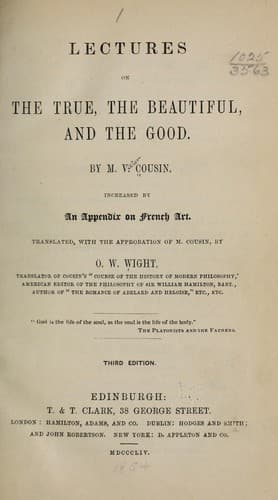
Lectures on the true, the beautiful and the goodCousin, Victor
Philosophy
Lectures on the true, the beautiful and the good
Cousin, Victor
Aesthetics; Ethics; Truth
Are we the authors of the good action? We feel a satisfaction that we do
not confound with any other. It is not the triumph of interest nor that
of pride,--it is the pleasure of modest honesty or dignified virtue that
renders justice to itself. Are we the authors of the bad action? We feel
offended conscience groaning within us. Sometimes it is only an
importunate reclamation, sometimes it is a bitter agony. Remorse is a
suffering the more poignant on account of our feeling that it is
deserved.
The spectacle of a good action done by another also has something
delicious to the soul. Sympathy is an echo in us that responds to
whatever is noble and good in others. When interest does not lead us
astray, we naturally put ourselves in the place of him who has done
well. We feel in a certain measure the sentiments that animate him. We
elevate ourselves to the mood of his spirit. Is it not already for the
good man an exquisite reward to make the noble sentiments that animate
him thus pass into the hearts of his fellow-men? The spectacle of a bad
action, instead of sympathy, excites an involuntary antipathy, a painful
and sad sentiment. Without doubt, this sentiment is never acute like
remorse. There is in innocence something serene and placid that tempers
even the sentiment of injustice, even when this injustice falls on us.
We then experience a sort of shame for humanity, we mourn over human
weakness, and, by a melancholy return upon ourselves, we are less moved
to anger than to pity. Sometimes also pity is overcome by a generous
anger, by a disinterested indignation. If, as we have said, it is a
sweet reward to excite a noble sympathy, an enthusiasm almost always
fertile in good actions, it is a cruel punishment to stir up around us
pity, indignation, aversion, and contempt.
Sympathy for a good action is accompanied by benevolence for its author.
He inspires us with an affectionate disposition. Even without knowing
it, we would love to do good to him; we desire that he may be happy,
because we judge that he deserves to be. Antipathy also passes from the
action to the person, and engenders against him a sort of bad will, for
which we do not blame ourselves, because we feel it to be disinterested
and find it legitimate.
Moral satisfaction and remorse, sympathy, benevolence, and their
opposites are sentiments and not judgments; but they are sentiments that
accompany judgments, the judgment of the good, especially that of merit
and demerit. These sentiments have been given us by the sovereign Author
of our moral constitution to aid us in doing good. In their diversity
and mobility, they cannot be the foundations of absolute obligation
which must be equal for all, but they are to it happy auxiliaries, sure
and beneficent witnesses of the harmony between virtue and happiness.
These are the facts as presented by a faithful description, as brought
to light by a detailed analysis.
Public-domain text, read in full here on John Shaqi.
Reviews
Reviews
No reviews yet
Be the first to share your thoughts on this work.
Elsewhere in the archive
Join the Discussion
Join the discussion
Sign in to leave a comment or review.
Sign InorCreate an account