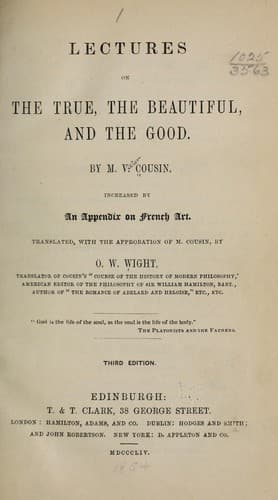
Lectures on the true, the beautiful and the goodCousin, Victor
Philosophy
Lectures on the true, the beautiful and the good
Cousin, Victor
Aesthetics; Ethics; Truth
Without facts all is chimera; without a severe distinction of facts, all
is confusion; but, also, without the knowledge of their relations,
instead of a single vast doctrine, like the total phenomenon that we
have undertaken to embrace, there can be only different systems like the
different parts of this phenomenon, consequently imperfect systems,
systems always at war with each other.
We set out from common sense; for the object of true science is not to
contradict common sense, but to explain it, and for this end we must
commence by recognizing it. We have at first painted in its simplicity,
even in the gross, the phenomenon of morality. Then we have separated
its elements, and carefully marked the characteristic traits of each of
them. It only remains for us to re-collect them all, to seize their
relations, and thus to find again, but more precise and more clear, the
primitive unity that served us as a point of departure.
Beneath all facts analysis has shown us a primitive fact, which vests
only on itself,--the judgment of the good. We do not sacrifice other
facts to that, but we must establish that it is the first both in date
and in importance.
By its close resemblance to the judgment of the true and the beautiful,
the judgment of the good has shown us the affinities of ethics,
metaphysics, and aesthetics.
The good, so essentially united to the true, is distinguished from it in
that it is practical truth. The good is obligatory. These two ideas are
inseparable, but not identical. For obligation rests on the good,--in
this intimate alliance, from the good obligation borrows its universal
and absolute character.
The obligatory good is the moral law. Therein is for us the foundation
of all ethics. Thereby it is that we separate ourselves from the ethics
of interest and the ethics of sentiment. We admit all the facts, but we
do not admit them in the same rank.
To the moral law in the reason of man corresponds liberty in action.
Liberty is deduced from obligation, and moreover it is a fact of an
irresistible evidence.
Man as a being free and subject to obligation, is a moral person. The
idea of person contains several moral notions, among others that of
right. Person alone can have rights.
To all these ideas is added that of merit and demerit, which serves as
their sanction.
Merit and demerit suppose the distinction between good and evil,
obligation and liberty, and give birth to the idea of reward and
punishment.
It is on the condition that the good may be an object of reason, that
ethics can have an immovable basis. We have therefore insisted on the
rational character of the idea of the good, but without misconceiving
the part of sentiment.
We have distinguished that particular sensibility, which is stirred in
us in the train of reason itself, from physical sensibility, which needs
an impression made upon the organs in order to enter into exercise.
Public-domain text, read in full here on John Shaqi.
Reviews
Reviews
No reviews yet
Be the first to share your thoughts on this work.
Elsewhere in the archive
Join the Discussion
Join the discussion
Sign in to leave a comment or review.
Sign InorCreate an account