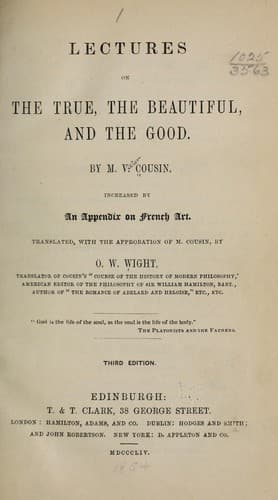
Lectures on the true, the beautiful and the goodCousin, Victor
Philosophy
Lectures on the true, the beautiful and the good
Cousin, Victor
Aesthetics; Ethics; Truth
All our moral judgments are accompanied by sentiments that respond to
them. The sight of an action which we judge to be good gives us
pleasure,--the consciousness of having performed an obligatory act, and
of having performed it freely, is also a pleasure; the judgment of merit
and demerit makes our hearts beat by taking the form of sympathy and
benevolence.
It must be avowed that the law of duty, although it ought to be
fulfilled for its own sake, would be an ideal almost inaccessible to
human weakness, if to its austere prescriptions were not added some
inspiration of the heart. Sentiment is in some sort a natural grace that
has been given us, either to supply the light of reason that is
sometimes uncertain, or to succor the will wavering in the presence of
an obscure or painful duty. In order to resist the violence of culpable
passions, the aid of generous passions is needed; and when the moral
law exacts the sacrifice of natural sentiments, of the sweetest and most
lively instincts, it is fortunate that it can support itself on other
sentiments, or other instincts which also have their charm and their
force. Truth enlightens the mind; sentiment warms the soul and leads to
action. It is not cold reason that determines a Codrus to devote himself
for his countrymen, a d'Assas to utter, beneath the steel of the enemy,
the generous cry that brings him death and saves the army. Let us guard
ourselves, then, from weakening the authority of sentiment; let us honor
and sustain enthusiasm; it is the source whence spring great and heroic
actions.
And shall interest be entirely banished from our system? No; we
recognize in the human soul a desire for happiness which is the work of
God himself. This desire is a fact,--it must then have its place in a
system founded upon experience. Happiness is one of the ends of human
nature; only it is neither its sole end nor its principal end.
Admirable economy of the moral constitution of man! Its supreme end is
the good, its law is virtue, which often imposes on it suffering, and
thereby it is the most excellent of all things that we know. But this
law is very hard and in contradiction with the instinct of happiness.
Fear nothing,--the beneficent author of our being has placed in our
souls, by the side of the severe law of duty, the sweet and amiable
force of sentiment,--he has, in general, attached happiness to virtue;
and, for the exceptions, for there are exceptions, at the end of the
course he has placed hope.[230]
Our doctrine is now known. Its only pretension is to express faithfully
each fact, to express them all, and to make appear at once their
differences and their harmony.
Public-domain text, read in full here on John Shaqi.
Reviews
Reviews
No reviews yet
Be the first to share your thoughts on this work.
Elsewhere in the archive
Join the Discussion
Join the discussion
Sign in to leave a comment or review.
Sign InorCreate an account