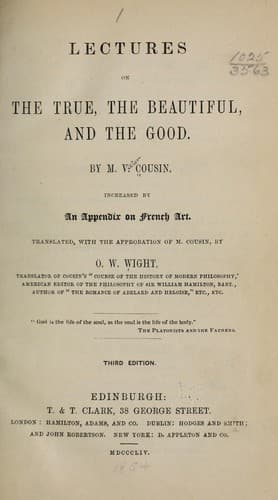
Lectures on the true, the beautiful and the goodCousin, Victor
Philosophy
Lectures on the true, the beautiful and the good
Cousin, Victor
Aesthetics; Ethics; Truth
Beyond that there is nothing new to attempt in ethics. To admit only a
single fact and to sacrifice to that all the rest,--such is the beaten
way. Of all the facts that we have just analyzed, there is not one that
has not in its turn played the part of sole principle. All the great
schools of moral philosophy have each seen only one side of
truth,--fortunate when they have not chosen among the different phases
of the moral phenomenon, in order to found upon them their entire
system, precisely those that are least adapted to that end!
Who could now return to Epicurus, and, against the most manifest facts,
against common sense, against the very idea of all ethics, found duty,
virtue, the good, on the desire of happiness alone? It would be proof of
great blindness and great barrenness. On the other hand, shall we
immolate the need of happiness, the hope of all reward, human or divine,
to the abstract idea of the good? The Stoics have done it,--we know with
what apparent grandeur, with what real impotence. Shall we confine with
Kant the whole of ethics to obligation? That is straitening still more a
system that is already very narrow. Moreover, one may hope to surpass
Kant in extent of views, by a completer knowledge and more faithful
representation of facts; one cannot hope to be more profound in the
point of view that he has chosen. Or, in another order of ideas, shall
we refer to the will of God alone the obligation of virtue, and found
ethics on religion, instead of giving religion to ethics as their
necessary perfection? We still invent nothing new, we only renew the
ethics of the theologians of the Middle Age, or rather of a particular
school which has had for its adversaries the most illustrious doctors.
Finally, shall we reduce all morality to sentiment, to sympathy, to
benevolence? It only remains to follow the footsteps of Hutcheson and
Smith, abandoned by Reid himself, or the footsteps of a celebrated
adversary of Kant, Jacobi.[231]
The time of exclusive theories has gone by; to renew them is to
perpetuate war in philosophy. Each of them, being founded upon a real
fact, rightly refuses the sacrifice of this fact; and it meets in
hostile theories an equal right and an equal resistance. Hence the
perpetual return of the same systems, always at war with each other, and
by turns vanquished and victorious. This strife can cease only by means
of a doctrine that conciliates all systems by comprising all the facts
that give them authority.
It is not the preconceived design of conciliating systems in history
that suggests to us the idea of conciliating facts in reality. It is, on
the contrary, the full possession of all the facts, analogous and
different, that forces us to absolve and condemn all systems on account
of the truth that is in each of them, and on account of the errors that
are mixed with the truth.
Public-domain text, read in full here on John Shaqi.
Reviews
Reviews
No reviews yet
Be the first to share your thoughts on this work.
Elsewhere in the archive
Join the Discussion
Join the discussion
Sign in to leave a comment or review.
Sign InorCreate an account