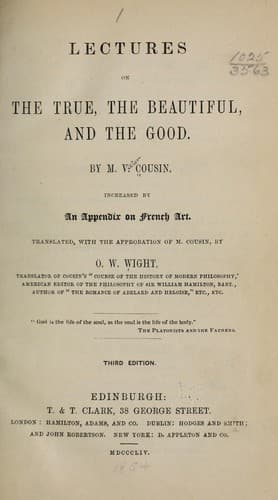
Lectures on the true, the beautiful and the goodCousin, Victor
Philosophy
Lectures on the true, the beautiful and the good
Cousin, Victor
Aesthetics; Ethics; Truth
Would it be possible that there might be several absolute beings, and
that the being in whom are realized absolute truth and absolute beauty
might not also be the one who is the principle of absolute good? The
very idea of the absolute implies absolute unity. The true, the
beautiful, and the good, are not three distinct essences; they are one
and the same essence considered in its fundamental attributes. Our mind
distinguishes them, because it can comprehend them only by division;
but, in the being in whom they reside, they are indivisibly united; and
this being at once triple and one, who sums up in himself perfect
beauty, perfect truth, and the supreme good, is nothing else than God.
So God is necessarily the principle of moral truth and the good. He is
also the type of the moral person that we carry in us.
Man is a moral person, that is to say, he is endowed with reason and
liberty. He is capable of virtue, and virtue has in him two principal
forms, respect of others, and love of others, justice and charity.
Can there be among the attributes possessed by the creature something
essential not possessed by the Creator? Whence does the effect draw its
reality and its being, except from its cause? What it possesses, it
borrows and receives. The cause at least contains all that is essential
in the effect. What particularly belongs to the effect, is inferiority,
is a lack, is imperfection: from the fact alone that it is dependent and
derived, it bears in itself the signs and the conditions of dependence.
If, then, we cannot legitimately conclude from the imperfection of the
effect in that of the cause, we can and must conclude from the
excellence of the effect in the perfection of the cause, otherwise there
would be something prominent in the effect which would be without cause.
Such is the principle of our theodicea. It is neither new nor subtle;
but it has not yet been thoroughly disengaged and elucidated, and it is,
to our eyes, firm against every test. It is by the aid of this
principle that we can, up to a certain point, penetrate into the true
nature of God.
God is not a being of logic, whose nature can be explained by way of
deduction, and by means of algebraic equations. When, setting out from a
first attribute, we have deduced the attributes of God from each other,
after the manner of geometricians and the schoolmen, what do we
possess,[246] I pray you, but abstractions? It is necessary to leave
these vain dialectics in order to arrive at a real and living God.
Public-domain text, read in full here on John Shaqi.
Reviews
Reviews
No reviews yet
Be the first to share your thoughts on this work.
Elsewhere in the archive
Join the Discussion
Join the discussion
Sign in to leave a comment or review.
Sign InorCreate an account