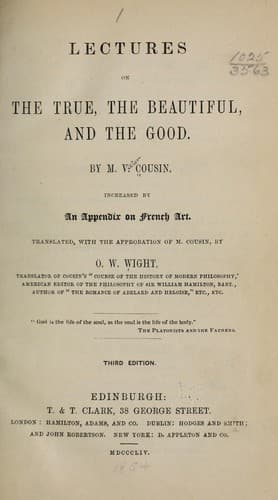
Lectures on the true, the beautiful and the goodCousin, Victor
Philosophy
Lectures on the true, the beautiful and the good
Cousin, Victor
Aesthetics; Ethics; Truth
Public worship is no more an arbitrary institution than society and
government, language and arts. All these things have their roots in
human nature. Adoration abandoned to itself, would easily degenerate
into dreams and ecstasy, or would be dissipated in the rush of affairs
and the necessities of every day. The more energetic it is, the more it
tends to express itself outwardly in acts that realize it, to take a
sensible, precise, and regular form, which, by a proper reaction on the
sentiment that produced it, awakens it when it slumbers, sustains it
when it languishes, and also protects it against extravagances of every
kind to which it might give birth in so many feeble or unbridled
imaginations. Philosophy, then, lays the natural foundation of public
worship in the internal worship of adoration. Having arrived at that
point, it stops, equally careful not to betray its rights and not to go
beyond them, to run over, in its whole extent and to its farthest limit,
the domain of natural reason, as well as not to usurp a foreign domain.
But philosophy does not think of trespassing on the ground of theology;
it wishes to remain faithful to itself, and also to follow its true
mission, which is to love and favor every thing that tends to elevate
man, since it heartily applauds the awakening of religious and Christian
sentiment in all noble souls, after the ravages that have been made on
every hand, for more than a century, by a false and sad philosophy.
What, in fact, would not have been the joy of a Socrates and a Plato if
they had found the human race in the arms of Christianity! How happy
would Plato--who was so evidently embarrassed between his beautiful
doctrines and the religion of his times, who managed so carefully with
that religion even when he avoided it, who was forced to take from it
the best possible part, in order to aid a favorable interpretation of
his doctrine--have been, if he had had to do with a religion which
presents to man, as at once its author and its model, the sublime and
mild Crucified, of whom he had an extraordinary presentiment, whom he
almost described in the person of a just man dying on the cross;[258] a
religion which came to announce, or at least to consecrate and expand
the idea of the unity of God and that of the unity of the human race;
which proclaims the equality of all souls before the divine law, which
thereby has prepared and maintains civil equality; which prescribes
charity still more than justice, which teaches man that he does not live
by bread alone, that he is not wholly contained in his senses and his
body, that he has a soul, a free soul, whose value is infinite, above
the value of all worlds, that life is a trial, that its true object is
not pleasure, fortune, rank, none of those things that do not pertain to
our real destiny, and are often more dangerous than useful, but is that
alone which is always in our power, in all situations and all
Public-domain text, read in full here on John Shaqi.
Reviews
Reviews
No reviews yet
Be the first to share your thoughts on this work.
Elsewhere in the archive
Join the Discussion
Join the discussion
Sign in to leave a comment or review.
Sign InorCreate an account