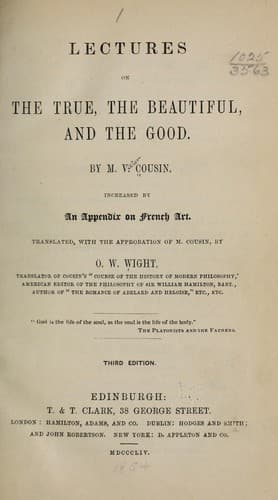
Lectures on the true, the beautiful and the goodCousin, Victor
Philosophy
Lectures on the true, the beautiful and the good
Cousin, Victor
Aesthetics; Ethics; Truth
conditions, from end to end of the earth, to wit, the improvement of the
soul by itself, in the holy hope of becoming from day to day less
unworthy of the regard of the Father of men, of the examples given by
him, and of his promises. If the greatest moralist that ever lived could
have seen these admirable teachings, which in germ were already at the
foundation of his spirit, of which more than one trait can be found in
his works, if he had seen them consecrated, maintained, continually
recalled to the heart and imagination of man by sublime and touching
institutions, what would have been his tender and grateful sympathy for
such a religion! If he had come in our own times, in that age given up
to revolutions, in which the best souls were early infected by the
breath of skepticism, in default of the faith of an Augustine, of an
Anselm, of a Thomas, of a Bossuet, he would have had, we doubt not, the
sentiments at least of a Montesquieu,[259] of a Turgot,[260] of a
Franklin,[261] and very far from putting the Christian religion and a
good philosophy at war with each other, he would have been forced to
unite them, to elucidate and fortify them by each other. That great mind
and that great heart, which dictated to him the _Phedon_, the _Gorgias_,
the _Republic_, would also have taught him that such books are made for
a few sages, that there is needed for the human race a philosophy at
once similar and different, that this philosophy is a religion, and that
this desirable and necessary religion is the Gospel. We do not hesitate
to say that, without religion, philosophy, reduced to what it can
laboriously draw from perfected natural reason, addresses itself to a
very small number, and runs the risk of remaining without much influence
on manners and life; and that, without philosophy, the purest religion
is no security against many superstitions, which little by little bring
all the rest, and for that reason it may see the best minds escaping its
influence, as was the case in the eighteenth century. The alliance
between true religion and true philosophy is, then, at once natural and
necessary; natural by the common basis of the truths which they
acknowledge; necessary for the better service of humanity. Philosophy
and religion differ only in the forms that distinguish, without
separating them. Another auditory, other forms, and another language.
When St. Augustine speaks to all the faithful in the church of Hippone,
do not seek in him the subtile and profound metaphysician who combated
the Academicians with their own arms, who supports himself on the
Platonic theory of ideas, in order to explain the creation. Bossuet, in
the treatise _De la Connaissance de Dieu et Soi-meme_, is no longer,
and at the same time he is always, the author of the _Sermons_, of the
_Elevations_, and the incomparable _Catechisme de Meaux_. To separate
religion and philosophy has always been, on one side or the other, the
Public-domain text, read in full here on John Shaqi.
Reviews
Reviews
No reviews yet
Be the first to share your thoughts on this work.
Elsewhere in the archive
Join the Discussion
Join the discussion
Sign in to leave a comment or review.
Sign InorCreate an account