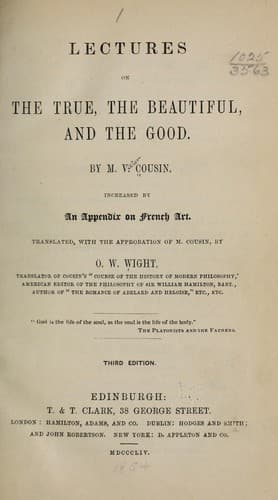
Lectures on the true, the beautiful and the good — John Shaqi
Lectures on the true, the beautiful and the goodCousin, Victor
Philosophy
Lectures on the true, the beautiful and the good
Cousin, Victor
Aesthetics; Ethics; Truth
_Resume_ of the preceding Lecture. A new question, that of the
origin of universal and necessary principles.--Danger of this
question, and its necessity.--Different forms under which truth
presents itself to us, and the successive order of these forms:
theory of spontaneity and reflection.--The primitive form of
principles; abstraction that disengages them from that form,
and gives them their actual form.--Examination and refutation of
the theory that attempts to explain the origin of principles by
an induction founded on particular notions.
LECTURE III.--ON THE VALUE OF UNIVERSAL AND NECESSARY PRINCIPLES 65
Examination and refutation of Kant's skepticism.--Recurrence to
the theory of spontaneity and reflection.
LECTURE IV.--GOD THE PRINCIPLE OF PRINCIPLES 75
Object of the lecture: What is the ultimate basis of absolute
truth?--Four hypotheses: Absolute truth may reside either in us,
in particular beings and the world, in itself, or in God. 1. We
perceive absolute truth, we do not constitute it. 2. Particular
beings participate in absolute truth, but do not explain it;
refutation of Aristotle. 3. Truth does not exist in itself;
defence of Plato. 4. Truth resides in God.--Plato; St.
Augustine; Descartes; Malebranche; Fenelon; Bossuet;
Leibnitz.--Truth the mediator between God and man.--Essential
distinctions.
LECTURE V.--ON MYSTICISM 102
Distinction between the philosophy that we profess and
mysticism. Mysticism consists in pretending to know God without
an intermediary.--Two sorts of mysticism.--Mysticism of
sentiment. Theory of sensibility. Two sensibilities--the one
external, the other internal, and corresponding to the soul as
external sensibility corresponds to nature.--Legitimate part of
sentiment.--Its aberrations.--Philosophical mysticism. Plotinus:
God, or absolute unity, perceived without an intermediary by
pure thought.--Ecstasy.--Mixture of superstition and abstraction
in mysticism.--Conclusion of the first part of the course.
PART SECOND.--THE BEAUTIFUL.
LECTURE VI.--THE BEAUTIFUL IN THE MIND OF MAN 123
The method that must govern researches on the beautiful and art
is, as in the investigation of the true, to commence by
psychology.--Faculties of the soul that unite in the perception
of the beautiful.--The senses give only the agreeable; reason
alone gives the idea of the beautiful.--Refutation of
empiricism, that confounds the agreeable and the
beautiful.--Pre-eminence of reason.--Sentiment of the beautiful;
different from sensation and desire.--Distinction between the
sentiment of the beautiful and that of the
sublime.--Imagination.--Influence of sentiment on
imagination.--Influence of imagination on sentiment.--Theory of
taste.
Public-domain text, read in full here on John Shaqi.
Reviews
Reviews
No reviews yet
Be the first to share your thoughts on this work.
Join the Discussion
Join the discussion
Sign in to leave a comment or review.
Sign InorCreate an account