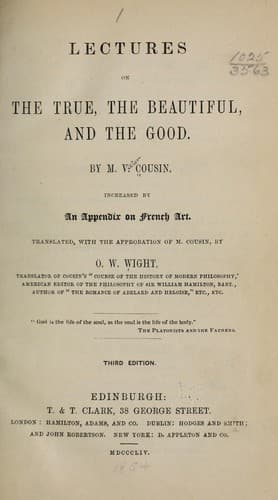
Lectures on the true, the beautiful and the goodCousin, Victor
Philosophy
Lectures on the true, the beautiful and the good
Cousin, Victor
Aesthetics; Ethics; Truth
The heart, like reason, pursues the infinite, and the only difference
there is in these pursuits is, that sometimes the heart seeks the
infinite without knowing that it seeks it, and sometimes it renders to
itself an account of the final end of the need of loving what disturbs
it. When reflection is added to love, if it finds that the object loved
is in fact worthy of being loved, far from enfeebling love, it
strengthens it; far from clipping its divine wings, it develops them,
and nourishes them, as Plato[72] says. But if the object of love is only
a symbol of the true beauty, only capable of exciting the desire of the
soul without satisfying it, reflection breaks the charm which held the
heart, dissipates the chimera that enchained it. It must be very sure in
regard to its attachments, in order to dare to put them to the proof of
reflection. O Psyche! Psyche! preserve thy good fortune; do not sound
the mystery too deeply. Take care not to bring the fearful light near
the invisible lover with whom thy soul is enamored. At the first ray of
the fatal lamp love is awakened, and flies away. Charming image of what
takes place in the soul, when to the serene and unsuspecting confidence
of sentiment succeeds reflection with its bitter train. This is perhaps
also the meaning of the biblical account of the tree of knowledge.[73]
Before science and reflection are innocence and faith. Science and
reflection at first engender doubt, disquietude, distaste for what one
possesses, the disturbed pursuit of what one knows not, troubles of mind
and soul, sore travail of thought, and, in life, many faults, until
innocence, forever lost, is replaced by virtue, simple faith by true
science, until love, through so many vanishing illusions, finally
succeeds in reaching its true object.
Spontaneous love has the native grace of ignorance and happiness.
Reflective love is very different; it is serious, it is great, even in
its faults, with the greatness of liberty. Let us not be in haste to
condemn reflection: if it often produces egotism, it also produces
devotion. What, in fact, is self-devotion? It is giving ourselves
freely, with full knowledge of what we are doing. Therein consists the
sublimity of love, love worthy of a noble and generous creature, not an
ignorant and blind love. When affection has conquered selfishness,
instead of loving its object for its own sake, the soul gives itself to
its object, and miracle of love, the more it gives the more it
possesses, nourishing itself by its own sacrifices, and finding its
strength and its joy in its entire self-abandonment. But there is only
one being who is worthy of being thus loved, and who can be thus loved
without illusions, and without mistakes, at once without limits, and
without regret, to wit, the perfect being who alone does not fear
reflection, who alone can fill the entire capacity of our heart.
Mysticism corrupts sentiment by exaggerating its power.
Public-domain text, read in full here on John Shaqi.
Reviews
Reviews
No reviews yet
Be the first to share your thoughts on this work.
Elsewhere in the archive
Join the Discussion
Join the discussion
Sign in to leave a comment or review.
Sign InorCreate an account