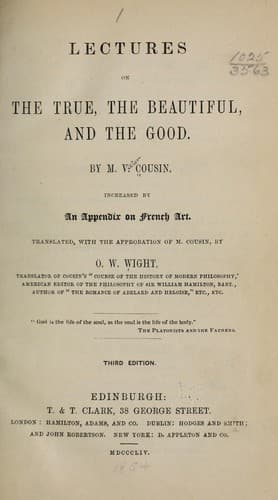
Lectures on the true, the beautiful and the goodCousin, Victor
Philosophy
Lectures on the true, the beautiful and the good
Cousin, Victor
Aesthetics; Ethics; Truth
Mysticism begins by suppressing in man reason, or, at least, it
subordinates and sacrifices reason to sentiment.
Listen to mysticism: it says that by the heart alone is man in relation
with God. All that is great, beautiful, infinite, eternal, love alone
reveals to us. Reason is only a lying faculty. Because it may err, and
does err, it is said that it always errs. Reason is confounded with
every thing that it is not. The errors of the senses, and of reasoning,
the illusions of the imagination, even the extravagances of passion,
which sometimes give rise to those of mind, every thing is laid to the
charge of reason. Its imperfections are triumphed over, its miseries are
complacently exhibited; the most audacious dogmatical system--since it
aspires to put man and God in immediate communication--borrows against
reason all the arms of skepticism.
Mysticism goes farther: it attacks liberty itself; it orders liberty to
renounce itself, in order to identify itself by love with him from whom
the infinite separates us. The ideal of virtue is no longer the
courageous perseverance of the good man, who, in struggling against
temptation and suffering, makes life holy; it is no longer the free and
enlightened devotion of a loving soul; it is the entire and blind
abandonment of ourselves, of our will, of our being, in a barren
contemplation of thought, in a prayer without utterance, and almost
without consciousness.
The source of mysticism is in that incomplete view of human nature,
which knows not how to discern in it what therein is most profound,
which betakes itself to what is therein most striking, most seizing,
and, consequently, also most seizable. We have already said that reason
is not noisy, and often is not heard, whilst its echo of sentiment
loudly resounds. In this compound phenomenon, it is natural that the
most apparent element should cover and dim the most obscure.
Moreover, what relations, what deceptive resemblances between these two
faculties! Without doubt, in their development, they manifestly differ;
when reason becomes reasoning, one easily distinguishes its heavy
movement from the flight of sentiment; but spontaneous reason is almost
confounded with sentiment,--there is the same rapidity, the same
obscurity. Add that they pursue the same object, and almost always go
together. It is not, then, astonishing that they should be confounded.
Public-domain text, read in full here on John Shaqi.
Reviews
Reviews
No reviews yet
Be the first to share your thoughts on this work.
Elsewhere in the archive
Join the Discussion
Join the discussion
Sign in to leave a comment or review.
Sign InorCreate an account